Every December, hundreds of thousands of Year 12 students across Australia refresh the same page over and over, waiting for that number to appear. The timing varies by state, and if you are not sure exactly when — or where — to look, you will spend results morning in a panic.
I have put together every confirmed and projected ATAR release date for 2026, along with portal names, access steps, and what to actually do once you see your score. Whether you are in Victoria waiting at 7 am or in Queensland holding out until the 18th, this is the only page you need bookmarked.
In This Article
ATAR Release Dates 2026 — Every State and Territory
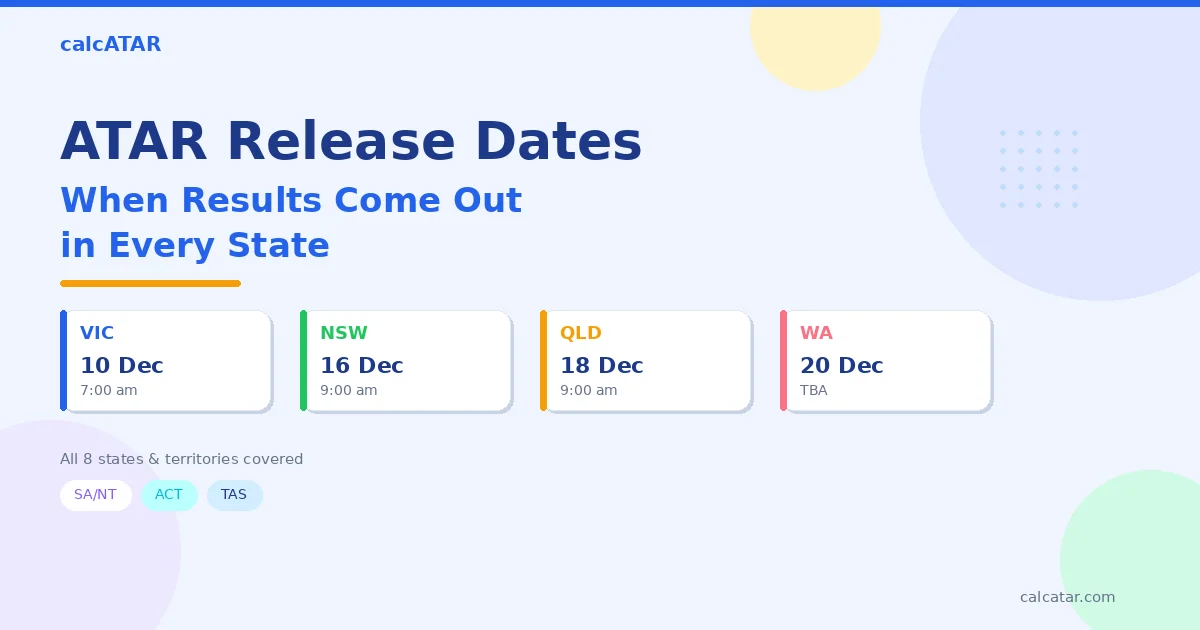
Victoria always goes first. The rest follow over the next 10 days or so. Here is the full schedule — confirmed dates are marked, and I have included last year’s dates for the two states that have not announced yet.
| State / Territory | Certificate | Release Date | Time | Status |
|---|---|---|---|---|
| Victoria | VCE | Thursday 10 December 2026 | 7:00 am AEDT | Confirmed |
| ACT | BSSS | Tuesday 15 December 2026 | TBA | Confirmed |
| South Australia | SACE | ~Monday 15 December 2026 | 8:30 am ACDT | Projected |
| Northern Territory | NTCET | ~Monday 15 December 2026 | 8:30 am ACST | Projected |
| NSW | HSC | Wednesday 16 December 2026 | 9:00 am AEDT | Confirmed |
| Tasmania | TCE | ~Thursday 17 December 2026 | TBA | Projected |
| Queensland | QCE | Friday 18 December 2026 | 9:00 am AEST | Confirmed |
| Western Australia | WACE | Sunday 20 December 2026 | TBA | Confirmed |
At a Glance
How to Access Your ATAR — State by State
Every state uses a different portal. Some give you results and ATAR together, others split them across two sites. Here is exactly where to go and what you need to log in.
| State | Results Portal | ATAR Portal | Login Method |
|---|---|---|---|
| VIC | VCE Results and ATAR Service (resultsandatar.vic.edu.au) | Same portal | VCAA student number + date of birth |
| ACT | Student Profiles Online (BSSS) | Same portal | Student ID + password |
| SA / NT | SACE Students Online | SATAC MyInfo portal | SATAC ID + password |
| NSW | Students Online (NESA) | UAC website (uac.edu.au) | UAC PIN + password |
| TAS | TASC Results website | Same portal | TASC ID + password |
| QLD | myQCE (QCAA) | QTAC ATAR Portal | QTAC application number + password |
| WA | WACE Results (SCSA) | TISC website (tisc.edu.au) | TISC ID + password |
Victoria (VCE)
VCE students get results and ATARs at the same time — 7:00 am AEDT on 10 December 2026. Go to resultsandatar.vic.edu.au and log in with your VCAA student number and date of birth. You will see your study scores for each subject and your ATAR on the same page. Your school may also hold a results morning event — check with your coordinator.
Want to check how your study scores might translate before results day? Use the VCE ATAR Calculator to test different scenarios.
ACT (BSSS)
ACT students access results through Student Profiles Online on the BSSS website. Your ATAR and course results appear together. The ACT is one of the smaller cohorts, so the portal holds up better under load — but still, log in early to check your credentials work.
Try the ACT ATAR Calculator to estimate your score ahead of the release.
South Australia and Northern Territory (SACE / NTCET)
SA and NT students share the same system. Subject results come through SACE Students Online, but your ATAR comes separately via the SATAC MyInfo portal. Last year it was 15 December at 8:30 am ACDT. You need your SATAC ID and password — these are different from your SACE login, and that catches people every year.
Estimate your score with the SACE ATAR Calculator.
New South Wales (HSC)
NSW is the state where results morning is actually two separate events. Your HSC subject results drop at 6:00 am via NESA’s Students Online portal. Your ATAR does not appear until 9:00 am on the UAC website. That three-hour gap is intentional — it lets you see how you went in each subject before the ATAR number lands.
I really suggest using those three hours productively. Open the HSC ATAR Calculator, plug in your actual HSC marks as they appear, and see how close your prediction was. By the time UAC releases your real ATAR at 9 am, you will already have a good idea of where you stand.
Tasmania (TCE)
Tasmanian students get results through the TASC Results website. Results are also emailed. Last year the release was 17 December — expect a similar date in 2026. Tasmania is a smaller cohort, so portal crashes are less of an issue, but still confirm your TASC login before the day.
Check the TCE ATAR Calculator for a pre-release estimate.
Queensland (QCE)
Queensland students get subject results through myQCE (the QCAA portal) and their ATAR through the QTAC ATAR Portal. The ATAR releases at 9:00 am AEST on 18 December 2026. You need your QTAC application number and password to access it. If you have not yet applied to QTAC, you will need to before you can see your ATAR.
Run your numbers through the QCE ATAR Calculator before results drop.
Western Australia (WACE)
WA is traditionally the last state to release — and this year it falls on a Sunday (20 December). Results are available via the SCSA website and your ATAR through TISC (tisc.edu.au). You will need your TISC ID and password.
Estimate first with the WACE ATAR Calculator.
What to Do on Results Day — Step by Step
Results morning can feel chaotic. Here is a simple checklist so you are not scrambling:
- Set an alarm for 15 minutes before your state’s release time. Not the release time itself — you want to be awake, calm, and sitting at a device that is already logged in.
- Open your portal and have your login ready. Pre-fill your username. If your portal requires two-factor authentication, make sure your phone is charged and nearby.
- Look at your subject results first. Before reacting to the ATAR number, review each subject. Are your marks where you expected? Any surprises? This context matters.
- Screenshot everything. Portals can go down under load, and you might not be able to log back in for hours. Screenshot your results and your ATAR the moment they appear.
- Compare your ATAR to your preferred course cutoffs. Go to your state’s admissions centre website and check the published cutoff for the courses you have applied for. Do this before telling anyone your score.
- Review your university preferences. Most states open a preference change window immediately after results release. If your ATAR is higher or lower than expected, adjust your preferences before the deadline — usually within 24–48 hours.
- Talk to someone. Whether the news is great or not what you hoped, talk to a parent, teacher, or school counsellor. One number does not define your options.
What If Your ATAR Is Lower Than Expected?
First — take a breath. A disappointing ATAR is not the end of anything. It feels like it in the moment (I am not going to pretend otherwise), but the reality is that most students who don’t get their first preference still end up where they want to be within a year or two. Here are your real options:
1. Check Later Offer Rounds
The December round is not the only round. January and February offer rounds often have lower cutoffs because other students have dropped out or changed preferences. Keep your application active and your preferences updated.
2. Apply for ATAR Rechecking
Every state offers a formal recheck process where your exam papers are re-marked. In Victoria, you can request a recheck through VCAA within a few days of results release (a fee applies, refunded if your score changes). NSW, QLD, WA, and SA all have similar processes — check your state’s assessment authority website for deadlines.
3. Consider Alternative Pathways
Most universities offer multiple pathways that do not depend on your ATAR:
- Diploma or foundation programs: Complete a one-year diploma at the same university and transfer directly into second year of the degree. Many Go8 universities offer this.
- TAFE pathway: Complete a Certificate IV or Diploma at TAFE, then apply for credit transfer into a university degree.
- Portfolio or interview entry: Creative arts, design, and some health degrees accept students based on portfolios or interviews regardless of ATAR.
- Mature-age or special entry: If you are turning 21, many universities waive ATAR requirements entirely through special consideration schemes.
4. Gap Year
Taking a year out is not failure. You can work, travel, volunteer, or do a short course — and then apply through the next cycle. Some universities even offer deferred places, so you can accept now and start a year later.
5. Use a Different Calculator to Understand Scaling
Sometimes your ATAR is lower than expected because of how your subjects scaled — not because you did badly. The ATAR Scaling Calculator shows you exactly how each subject was adjusted, and the ATAR Predictor can help you understand where your combination sits.
10 Tips for ATAR Results Day
I have talked to a lot of students over the years, and results morning follows the same pattern. Some things that genuinely help:
1. Log in to your portal a week early
Reset passwords, verify your student number, and make sure two-factor is working. Portal crashes on results day are real, and “I forgot my password” is not a problem you want to solve at 7 am with shaking hands.
2. Decide in advance who you want to be with
Some students want to be alone. Some want family. Some go to school results events. There is no right answer, but decide before the morning — not during it.
3. Turn off social media until you have processed your results
Other people’s celebrations (or complaints) will colour how you feel about your own score. Look at your results, understand them, and then go online.
4. Have your university preference list open in another tab
If your ATAR is different from what you expected — in either direction — you may want to change preferences quickly. The change window is short (typically 24–48 hours after results).
5. Understand the difference between results and ATAR
In NSW, HSC marks (6 am) and ATAR (9 am) come at different times. In Victoria, they arrive together at 7 am. In Queensland, subject results via myQCE and ATAR via QTAC may release at different times. Know your state’s pattern so you are not confused.
6. Do not compare your ATAR to last year’s cutoffs blindly
Course cutoffs change every year based on the cohort. A cutoff of 85 last year might be 82 or 88 this year. Use the cutoff as a guide, not a guarantee. Wait for the official January offer round before drawing conclusions.
7. Screenshot everything the moment it loads
I am constantly surprised by how many students forget to do this and then cannot get back into the portal for hours. Screenshot your subject results, your study scores (or equivalent), and your ATAR.
8. Know your backup plan before the day
If you have already researched diploma pathways, TAFE options, or later offer rounds, a lower-than-expected ATAR feels manageable instead of catastrophic. Five minutes of research in November saves hours of panic in December.
9. Remember that your ATAR is a rank, not a score
An ATAR of 75 does not mean you scored 75%. It means you are in the top 25% of your cohort. That is a solid result by any measure. The number is relative to the entire Year 12 population, including students who did not complete an ATAR-eligible pathway.
10. It is one number on one day
Your ATAR determines which university offers you get in the first round. That is it. It does not determine your career, your intelligence, your worth, or your long-term earning potential. Most adults could not tell you their ATAR if you asked. (I know that does not help at 7:01 am on December 10, but it is true.)
When Do University Offers Come Out?
Once ATARs are released, the next question is: did I get in? Here is the typical offer round timeline for 2026–2027:
| Round | Offers Released | Notes |
|---|---|---|
| December Round | Late December 2026 | Based on your ATAR and preferences as of results day. Not all courses participate. |
| January Main Round | Mid-January 2027 | The big one. Most offers go out here. Cutoffs are published. |
| February Round(s) | Late January – February 2027 | Subsequent rounds fill remaining places. Cutoffs often drop. |
| Late Rounds | March – April 2027 | Some courses with unfilled places continue making offers well into the year. |
Comparing ATAR Release Timing Across States
| Feature | VIC | NSW | QLD | WA | SA/NT | TAS | ACT |
|---|---|---|---|---|---|---|---|
| Results and ATAR together? | Yes | No (3hr gap) | No (separate) | No (separate) | No (separate) | Yes | Yes |
| Release time | 7:00 am | 9:00 am | 9:00 am | TBA | 8:30 am | TBA | TBA |
| ATAR body | VTAC | UAC | QTAC | TISC | SATAC | UTAS | UAC |
| Calculator | VCE | HSC | QCE | WACE | SACE | TCE | BSSS |
Frequently Asked Questions
Final Thoughts
Results day is one morning. It feels massive — and I am not going to tell you it does not matter, because clearly it does. But it is one data point in a much longer story. Log in early, screenshot everything, check your cutoffs, and adjust your preferences if you need to.
If the number is what you hoped for, congratulations — you earned it. If it is not, read the section on alternative pathways above. Every option I listed there is a real path that real students take every year.
For a quick estimate before the day, use the calculator for your state: VCE · HSC · QCE · WACE · SACE · TCE · BSSS
— Daniel Mitchell, calcATAR