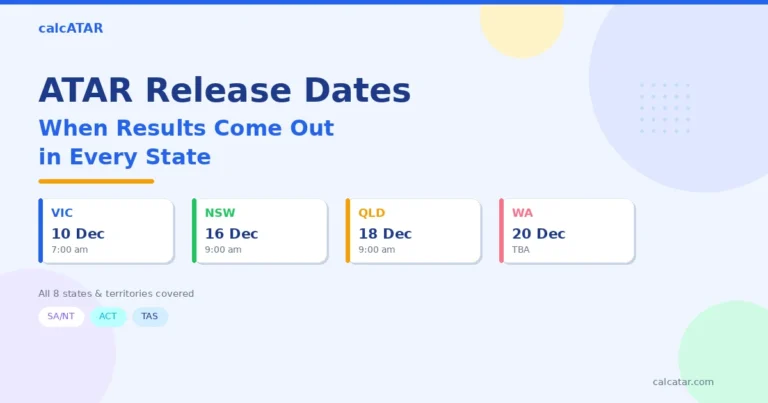
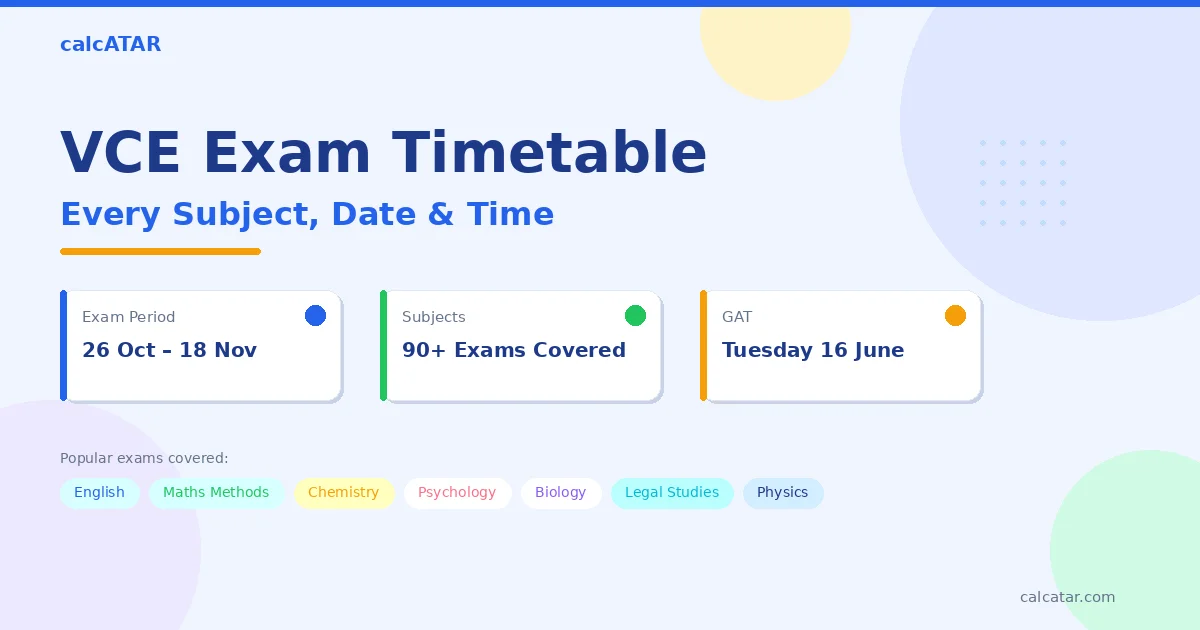
VCAA has released the full 2026 VCE exam timetable. Written exams run from Tuesday 27 October to Wednesday 18 November 2026, performance and oral exams kick off earlier in October, and results drop on Thursday 10 December 2026.
I have put together the complete day-by-day schedule below — every subject, every session time, plus some stuff the official timetable doesn’t spell out for you (like which afternoons start at 2:00 pm instead of 3:00 pm, and what actually happens if you get sick on exam day). There is also a quick breakdown of how your VCE scores turn into an ATAR, because most students I talk to are surprisingly fuzzy on that part.
Table of Contents
- Key Dates at a Glance
- General Achievement Test (GAT) — 16 June 2026
- Performance and Oral Examinations — October 2026
- Languages (CCAFL) Written Examinations — 15–16 October 2026
- Complete Written Exam Timetable — 27 Oct to 18 Nov 2026
- Session Start Times Explained
- Exams with Audio Components
- Important Exam Rules Every Student Must Know
- What Happens If You Miss a VCE Exam?
- How VCE Scoring and ATAR Calculation Works
- 10 Tips for VCE Exam Preparation 2026
- Frequently Asked Questions
Key Dates at a Glance
Pin this table somewhere you will actually see it — your wall, your phone lock screen, wherever works. These are the dates that matter.
| Event | Date(s) |
|---|---|
| GAT (General Achievement Test) | Tuesday 16 June 2026 |
| Extended Investigation Critical Thinking Test | Wednesday 29 July 2026 |
| Performance & Oral Examinations | Mon 5 October – Sun 1 November 2026 |
| Extended Investigation Oral Presentation | Mon 12 – Fri 23 October 2026 |
| CCAFL Written Examinations | Thu 15 – Fri 16 October 2026 |
| Personal Timetable Available in VASS | From Monday 7 September 2026 |
| Written Examination Period | Tue 27 October – Wed 18 November 2026 |
| Melbourne Cup Day (No Exams) | Tuesday 3 November 2026 |
| VCE Results & ATAR Release | Thursday 10 December 2026 |
General Achievement Test (GAT) — 16 June 2026
The GAT is compulsory if you are enrolled in even one Unit 3–4 study. A lot of students treat it as a throwaway because it doesn’t count directly towards your ATAR. That is a mistake. VCAA uses your GAT for two important things: statistical moderation of school-assessed work, and calculating your Derived Examination Score (DES) if you miss an exam. More on that below.
| Section | Time |
|---|---|
| Section A — Literacy (Reading and Writing) and Numeracy | 9:00 am – 9:15 am reading time 9:15 am – 11:15 am writing time |
| Section B — General Knowledge and Skills | 1:15 pm – 1:30 pm reading time 1:30 pm – 3:00 pm writing time |
That is roughly 3.5 hours of testing spread across two sessions — morning covers reading, writing, and numeracy, afternoon is general knowledge across humanities, maths, science, tech, and the arts. Not a short day.
Performance and Oral Examinations — October 2026
If you are doing a performance or language oral subject, your exam happens before the written period. These are scheduled individually — you will get an advice slip from your school with your exact date, time, and venue starting from Monday 27 July 2026.
| Period | Examinations |
|---|---|
| Mon 5 Oct – Mon 26 Oct | Languages oral examinations (except Classical Greek, Classical Hebrew, Aboriginal Languages of Victoria, Latin) · Auslan Interactive Sign examination · Performance exams: Dance, VET Dance, Drama: Solo, Theatre Studies: Monologue |
| Mon 5 Oct – Sun 1 Nov | Performance exams: Music Repertoire Performance, Music Contemporary Performance, VET Music Performance |
| Mon 12 Oct – Fri 23 Oct | Extended Investigation oral presentation |
Languages (CCAFL) Written Examinations — 15–16 October 2026
These sit outside the main written exam window. CCAFL covers community languages that are not offered as standard VCE subjects — so if you are sitting Armenian, Bengali, Chin Hakha, or any of the others below, your exam is in mid-October, not late October.
| Date | Time | Subject(s) |
|---|---|---|
| Thu 15 Oct | 9:25 am – 12:30 pm | Classical Hebrew (5-min reading period) |
| Thu 15 Oct | 2:00 pm – 4:10 pm | Armenian, Bengali, Bosnian, Chin Hakha, Croatian, Dutch, Filipino, Hebrew, Hindi, Hungarian, Karen, Khmer, Macedonian, Persian, Polish, Portuguese, Punjabi, Romanian, Russian, Serbian, Sinhala, Swedish, Tamil, Turkish (10-min reading period each) |
| Thu 15 Oct | 8:00 am – 6:00 pm | Auslan Sign Comprehension and Sign Production (individual 2-hour sessions) |
| Fri 16 Oct | 1:55 pm – 5:00 pm | Classical Greek (5-min reading period) |
Complete VCE Written Exam Timetable — 27 October to 18 November 2026
This is the big one. Every written exam session, day by day, with times and subjects. Morning exams always start at 9:00 am. Afternoon start times depend on the day — some are 3:00 pm, some are 2:00 pm (I explain why in the session times section below). All times shown include the 15-minute reading period unless otherwise noted.
One thing that trips people up: the official exam period technically opens on Monday 26 October, but no written papers actually sit that day. Your first written exam is English or EAL on Tuesday 27 October.
Week 1 — Tuesday 27 October to Friday 30 October
| Date | Time | Subject(s) |
|---|---|---|
| Tue 27 Oct | 9:00 am – 12:15 pm | English, English as an Additional Language (EAL) |
| Wed 28 Oct | 9:00 am – 10:45 am | Agricultural and Horticultural Studies |
| 11:45 am – 1:30 pm | Art Making and Exhibiting | |
| 3:00 pm – 5:15 pm | English Language, Vietnamese First Language, Indonesian First Language | |
| Thu 29 Oct | 9:00 am – 10:45 am | VET Business, VET Community Services, Theatre Studies |
| 11:45 am – 2:00 pm | Economics | |
| 3:00 pm – 5:15 pm | Chinese First Language, Korean, Japanese First Language, Literature First Language | |
| Fri 30 Oct | 9:00 am – 11:45 am | Psychology |
| 2:00 pm – 3:45 pm | General Mathematics Exam 1 |
Week 2 — Monday 2 November to Friday 6 November
| Date | Time | Subject(s) |
|---|---|---|
| Mon 2 Nov | 9:00 am – 11:45 am | Biology |
| 2:00 pm – 3:45 pm | General Mathematics Exam 2 | |
| Tuesday 3 November — Melbourne Cup Public Holiday — No Examinations | ||
| Wed 4 Nov | 9:00 am – 10:45 am | Art Creative Practice, VET Engineering Studies, VET Health Allied, VET Health Services Assistance |
| 11:45 am – 2:00 pm | Aboriginal Languages of Victoria, Algorithmics (HESS), Classical Studies, Korean Second Language, Vietnamese Second Language | |
| 3:00 pm – 5:15 pm | Business Management | |
| Thu 5 Nov | 9:00 am – 10:15 am | Mathematical Methods Exam 1, Music Composition |
| 11:45 am – 1:30 pm | VET Equine Studies, VET Hospitality | |
| 3:00 pm – 5:15 pm | Chinese Language, Culture and Society, Health and Human Development | |
| Fri 6 Nov | 9:00 am – 10:45 am | Dance, VET Integrated Technologies |
| 11:45 am – 2:00 pm | Mathematical Methods Exam 2 | |
| 3:00 pm – 5:15 pm | Arabic, Legal Studies, VET Creative and Digital Media | |
Week 3 — Monday 9 November to Friday 13 November
| Date | Time | Subject(s) |
|---|---|---|
| Mon 9 Nov | 9:00 am – 10:15 am | Music Inquiry, Specialist Mathematics Exam 1 |
| 11:45 am – 2:00 pm | Applied Computing: Data Analytics, Physical Education, Spanish | |
| 3:00 pm – 5:15 pm | History: Revolutions, Industry and Enterprise | |
| Tue 10 Nov | 9:00 am – 11:45 am | Chemistry |
| 2:00 pm – 4:15 pm | Environmental Science, Greek, Media, Text and Traditions | |
| Wed 11 Nov | 9:00 am – 10:45 am | VET Furnishing, Visual Communication Design |
| 11:45 am – 2:00 pm | History: Australian History, Outdoor and Environmental Studies, Specialist Mathematics Exam 2 | |
| 3:00 pm – 5:15 pm | Accounting | |
| Thu 12 Nov | 9:00 am – 11:45 am | Physics |
| 2:00 pm – 4:15 pm | History: Ancient History, Geography, Sociology | |
| Fri 13 Nov | 9:00 am – 10:45 am | Product Design and Technologies, VET Information and Communications Technology, VET Music (Sound Production) |
| 11:45 am – 1:30 pm | Drama, VET Sport and Recreation | |
| 3:00 pm – 5:15 pm | Applied Computing: Software Development, German, Philosophy |
Week 4 — Monday 16 November to Wednesday 18 November (Final Week)
| Date | Time | Subject(s) |
|---|---|---|
| Mon 16 Nov | 9:00 am – 10:45 am | Food Studies |
| 11:45 am – 1:30 pm | VET Hospitality (Cookery), VET Laboratory Skills, Systems Engineering | |
| 3:00 pm – 5:15 pm | Latin, Politics, Religion and Society | |
| Tue 17 Nov | 9:00 am – 10:15 am | Music Contemporary Performance, Music Repertoire Performance |
| 11:45 am – 2:00 pm | Indonesian Second Language, Italian | |
| 3:00 pm – 5:15 pm | Foundation Mathematics, French | |
| Wed 18 Nov | 9:00 am – 11:15 am | Japanese Second Language |
| 2:00 pm – 4:15 pm | Chinese Second Language, Chinese Second Language Advanced |
Session Start Times Explained
This is the part that catches people out every single year. Not every afternoon session starts at the same time.
| Day Type | Morning | Afternoon |
|---|---|---|
| Days with three sessions | 9:00 am | 3:00 pm |
| Days with two sessions only (Fri 30 Oct, Mon 2 Nov, Tue 10 Nov, Thu 12 Nov, Wed 18 Nov) | 9:00 am | 2:00 pm |
Exams with Audio Components
These written exams have a listening section built in:
- Music Composition
- Music Contemporary Performance
- Music Inquiry
- Music Repertoire Performance
- VET Music (Sound Production)
- All Languages, including Chinese Language, Culture and Society
Exceptions: Auslan, Aboriginal Languages of Victoria, Classical Greek, Classical Hebrew, and Latin — no audio component for those.
If you need special provisions for audio (hearing impairment, processing difficulties, etc.), talk to your VCE coordinator sooner rather than later. These arrangements take time to set up.
Important Exam Rules Every Student Must Know
VCAA takes these seriously and so should you. Violations can mean penalties, score cancellation, or — in the worst case — disqualification from that exam entirely.
- Arrive at least 30 minutes early. Late admission rules are strict. Too late and they simply will not let you in.
- 15-minute reading period at the start of every exam (unless otherwise noted). This time is already baked into the timetable times above. You cannot write during reading time — pens down.
- Write in English unless the exam specifically tells you otherwise (language exams, obviously).
- No phones. No smartwatches. No earbuds. No electronic devices of any kind. Not “switched off in your pocket.” Not “in your bag under the desk.” Leave them at home or hand them to the supervisor. VCAA is not joking about this one.
- Check the authorised materials list for each exam on the VCAA website. Some exams allow a CAS calculator, some allow a scientific calculator, some allow nothing. Bringing the wrong one (or an unapproved one) causes problems you don’t need.
- Oral and performance exams: Photo ID and advice slip required for entry.
What Happens If You Miss a VCE Exam?
Life happens. If you miss a written exam because you were genuinely sick or something serious came up, you can apply for a Derived Examination Score (DES). It is not ideal, but it is not a disaster either — assuming you have done the groundwork.
- Tell your school straight away. Before the exam if possible. The same morning at the latest.
- Get evidence. A medical certificate, a statutory declaration, whatever documents the situation. You need this — VCAA won’t just take your word for it.
- Your school handles the DES application. They submit it to VCAA on your behalf.
- VCAA works out a derived score using your SACs, any SATs, and — crucially — your GAT result.
And that is exactly why I keep saying the GAT matters more than people think. If you need a DES, a strong GAT gives VCAA solid data to calculate a fair score for you. I really suggest you give the GAT genuine effort — treat it like a real exam. Students who blow it off and then get sick in October have a very bad time.
One more thing: if you are feeling unwell on exam day, don’t drag yourself in and sit it just because you are scared of the DES process. A DES calculated from strong SACs and a solid GAT can sometimes produce a better result than sitting the exam while you can barely think straight. Talk to your school, weigh it up, and make the call.
How VCE Scoring and ATAR Calculation Works
Most students know the ATAR is a number out of 99.95, but surprisingly few understand how their exam papers actually turn into that number. It is a four-step process.
Step 1: Raw Exam Score
VCAA marks your exam. You get a raw score out of however many marks were available on the paper. Straightforward.
Step 2: Study Score
Your raw exam score gets combined with your school-assessed coursework (SACs) and any SATs. But — and this is important — VCAA doesn’t just take your school’s word for your SAC marks. They statistically moderate them using the GAT and exam results from your entire school cohort. The final result is a Study Score out of 50 for each Unit 3–4 subject. The state median is 30.
(This is also why two students with identical SAC marks at different schools can end up with different Study Scores. Moderation adjusts for differences in school marking standards.)
Step 3: Scaling
VTAC (Victorian Tertiary Admissions Centre) takes your Study Scores and scales them. Scaling adjusts for the fact that different subjects attract cohorts of different academic strength. If students who choose Specialist Maths tend to perform well across all their subjects, Specialist Maths scales up. If a subject’s cohort is weaker on average, it scales down.
Your aggregate score comes from your best results: primary four subjects (English or EAL always counts first, plus your three next-highest) at 100%, and up to two additional subjects contributing 10% each.
A lot of Year 11s stress about choosing “high-scaling” subjects, but honestly — a raw 40 in a lower-scaling subject beats a raw 30 in a high-scaling one almost every time. Pick subjects you will actually do well in. Use scaling as a tiebreaker, not a strategy.
Step 4: ATAR
Your aggregate is ranked against every Year 12 student in Australia who completed an ATAR-eligible program. The result is your ATAR — a national percentile. An ATAR of 90.00 means you are in the top 10%.
10 Tips for VCE Exam Preparation 2026
The timetable is the easy bit. Making it through the exam period without burning out or making avoidable mistakes — that is the actual challenge.
1. Build a Reverse Study Plan from the Timetable
Start with your last exam date and work backwards. Block out revision days for each subject, giving more time to the ones you find hard. The dates are right there in the timetable above — anchor your plan to real deadlines, not “I’ll start studying next week.”
2. Do Past VCAA Papers. A Lot of Them.
There is no better preparation than the real thing. Past papers are free on the VCAA website. Do them under timed conditions, and — this is the part most students skip — actually read the examiner’s reports and marking rubrics. They literally tell you what gets marks.
3. Simulate Real Exam Conditions
Clear desk, timer running, phone in another room. Include the 15-minute reading period. The point is to make the real exam feel familiar. Students who only ever study from notes and then face their first timed paper on exam day are at a massive disadvantage.
4. Know Which Afternoons Start at 2:00 pm
Stick these somewhere you will see them: Fri 30 Oct, Mon 2 Nov, Tue 10 Nov, Thu 12 Nov, Wed 18 Nov. On these days, the afternoon session is at 2:00 pm, not the usual 3:00 pm. Showing up an hour late is the kind of mistake that haunts you.
5. Check VASS on 7 September
Your personal exam timetable goes live in VASS from that date. Check it immediately. Flag any clashes or errors with your VCE coordinator — don’t wait until October.
6. Actually Use the Reading Period
You have 15 minutes where you can read but not write. Most students read question one and then sit there. Better approach: read the entire paper, identify the high-mark questions, plan your time allocation, and decide your order of attack. Those 15 minutes are free planning time. Use them.
7. Study the Hard Subject First
When two exams are close together, tackle the harder subject while your energy is high. The easier one needs less ramp-up time closer to the date. This sounds obvious but I am constantly surprised how many students do it the other way around.
8. Sleep More Than You Think You Need
Pulling an all-nighter before an exam actively makes you perform worse. Your brain consolidates what you learned during sleep — literally. Aim for 7–9 hours every night through the exam period. You will feel lazy. You are not. You are being strategic.
9. Pack Your Exam Kit the Night Before
Pens (at least two spares), pencils, eraser, ruler, approved calculator with fresh batteries, student ID, exam advice slip. Take your phone out of your bag entirely — it should not be anywhere near the exam room. Check the VCAA authorised materials list for each subject because the rules differ.
10. Have a Sick-Day Plan
Decide now what you will do if you wake up sick on exam morning. Who do you call at school? Where is the nearest GP for a same-day certificate? Having this figured out in advance means you won’t panic and make a bad decision (like sitting the exam with a 39°C fever because you didn’t know about the DES process).
Frequently Asked Questions
Final Thoughts
Three and a half weeks of exams, then three weeks of waiting, then results on 10 December. That is the timeline. The best thing you can do between now and October is get the timetable into your study plan, work through as many past papers as you can stomach, and sort out the logistics (VASS timetable, exam kit, authorised materials) before the pressure hits.
If you want to see how your scores might translate, the VCE ATAR Calculator is there. And if you are still choosing subjects or wondering whether dropping one for another would help, the ATAR Scaling Calculator will show you the numbers.
Good luck. You have got this.
— Daniel Mitchell, calcATAR