In This Guide
- What Your ATAR Actually Means
- ATAR Score Ranges — What Each Band Means
- Average ATAR Score in Australia
- State-by-State Average ATAR Comparison
- What ATAR Do You Need for Popular Courses?
- Is 70 / 75 / 80 / 85 / 90 / 95 a Good ATAR?
- Why Your ATAR Is Not Everything
- Alternative Pathways Into University
- 10 Tips to Maximise Your ATAR
- Frequently Asked Questions
“What is a good ATAR score?” is the single most common question Year 12 students ask — and the honest answer is: it depends entirely on what you want to study and where.
An ATAR of 75.00 is outstanding if your dream course requires 70. That same 75 is not enough if you are targeting medicine at the University of Melbourne. “Good” is not a fixed number. It is relative to your goals.
This guide breaks down every ATAR band, shows you real cutoffs for popular courses at named universities, compares state-by-state averages, and explains what to do if your ATAR does not match your expectations. If you want a quick estimate of where you stand right now, use the ATAR Predictor for a 30-second ballpark.
What Your ATAR Actually Means
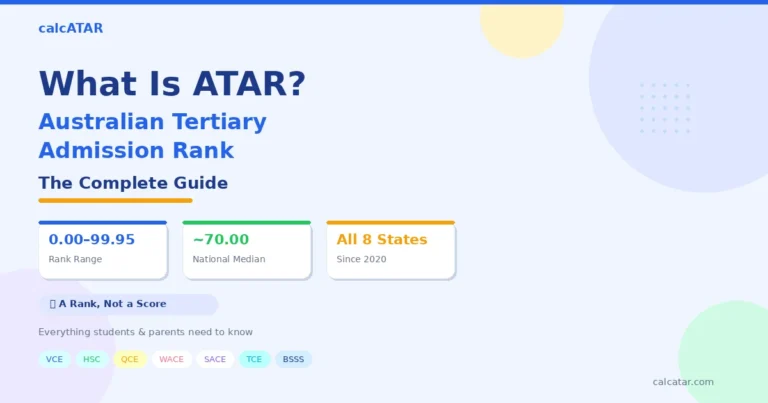
Your ATAR (Australian Tertiary Admission Rank) is a percentile rank, not a mark out of 100. An ATAR of 80.00 does not mean you scored 80% on your exams. It means you performed better than 80% of the entire Year 12 age cohort in your state — including students who did not complete an ATAR-eligible pathway.
The scale runs from 0.00 to 99.95 (in increments of 0.05). You cannot get 100. The top possible rank is 99.95, which means you are in the top 0.05% of the cohort.
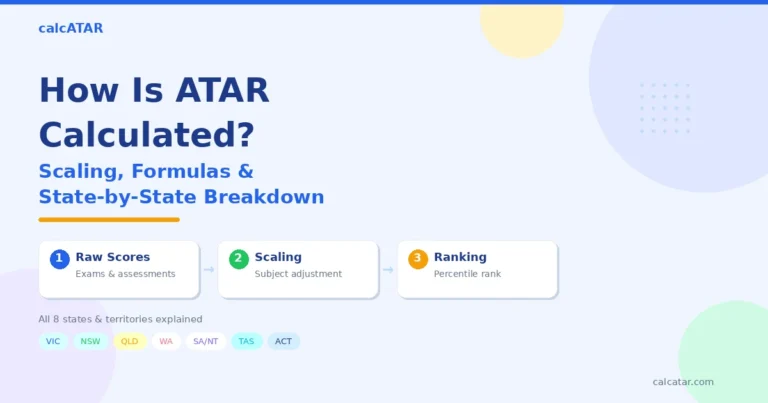
Each state calculates the ATAR differently — Victoria uses VTAC scaled study scores, NSW uses UAC, Queensland uses QTAC inter-subject scaling, and so on. But the final rank is designed to be nationally comparable. For a full breakdown, read How Is ATAR Calculated?
ATAR Score Ranges — What Each Band Means
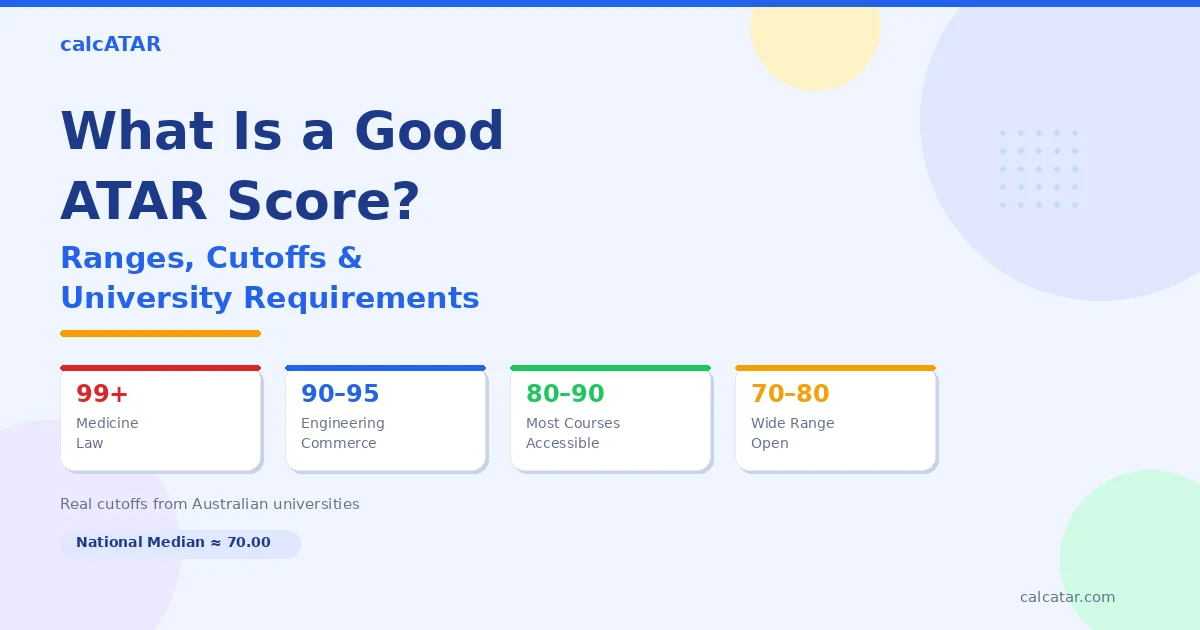
Here is what each ATAR range typically opens up for you. These are general bands — specific courses vary.
| ATAR Range | Percentile | What It Means | Typical Courses |
|---|---|---|---|
| 99.00 – 99.95 | Top 1% | Elite. You outperformed 99% of the cohort. | Medicine, Dentistry, Law (Go8), Veterinary Science |
| 95.00 – 98.95 | Top 5% | Highly competitive. Opens nearly every course. | Law, Physiotherapy, Pharmacy, Advanced Science, Combined degrees at Go8 |
| 90.00 – 94.95 | Top 10% | Excellent. Very strong options across all universities. | Engineering (Go8), Commerce (Go8), Biomedical Science, Psychology (Honours) |
| 80.00 – 89.95 | Top 20% | Well above average. Most university courses are accessible. | Engineering, IT, Business, Science, Health Sciences at most universities |
| 70.00 – 79.95 | Top 30% | Above the national median. A wide range of courses. | Arts, Education, Nursing, Media, Social Work, General Science |
| 60.00 – 69.95 | Top 40% | Many pathways still open, especially at regional universities. | Arts, Business (regional), Early Childhood Education, Community Services |
| Below 60.00 | Below top 40% | Direct entry limited, but alternative pathways are available. | Diplomas, TAFE, foundation programs, portfolio entry, mature-age schemes |
Average ATAR Score in Australia
The national median ATAR is approximately 70.00. That means roughly half of all students who receive an ATAR score above 70, and half score below it.
A few things to keep in mind about this number:
- The median is not 50.00 because students who leave school before Year 12 or take VET/non-ATAR pathways are counted in the denominator but never receive an ATAR.
- Around 50,000 students across Australia score an ATAR each year (out of roughly 300,000+ in the age cohort).
- Only about 40 students nationally achieve the maximum ATAR of 99.95 in any given year.
State-by-State Average ATAR Comparison
Median and average ATARs vary between states because of differences in cohort size, participation rates, and how many students opt for ATAR-eligible pathways versus VET or non-ATAR streams.
| State / Territory | Curriculum | Approximate Median ATAR | Cohort Size (Approx.) | Calculator |
|---|---|---|---|---|
| NSW | HSC | 71 – 73 | ~55,000 | HSC Calculator |
| Victoria | VCE | 70 – 72 | ~48,000 | VCE Calculator |
| Queensland | QCE | 68 – 71 | ~30,000 | QCE Calculator |
| Western Australia | WACE | 65 – 68 | ~16,000 | WACE Calculator |
| South Australia | SACE | 66 – 69 | ~13,000 | SACE Calculator |
| Tasmania | TCE | 65 – 70 | ~3,500 | TCE Calculator |
| ACT | BSSS | 68 – 72 | ~4,000 | BSSS Calculator |
| Northern Territory | SACE (shared with SA) | ~66 – 69 | ~1,200 | SACE Calculator |
What ATAR Do You Need for Popular Courses?
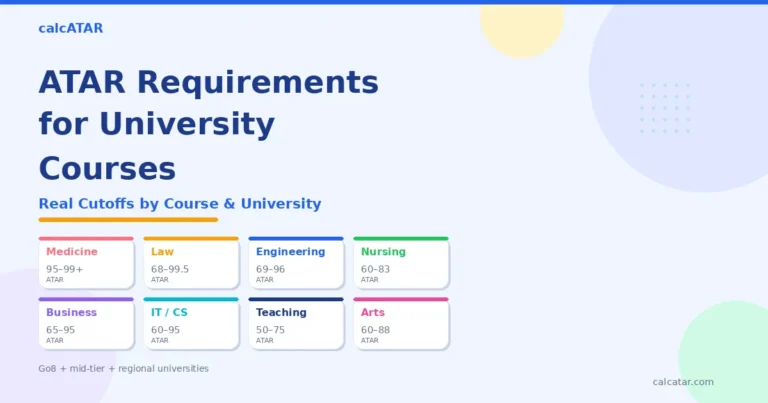
The table below shows indicative ATAR cutoffs for popular courses at well-known Australian universities. These are based on the most recent published admissions data. Cutoffs change every year depending on demand and the number of places available.
| Course | University | Indicative ATAR Cutoff | Notes |
|---|---|---|---|
| Medicine (Direct Entry) | Monash University | 97+ | UCAT + MMI interview also required |
| Medicine (Direct Entry) | UNSW Sydney | 96+ | UCAT required; most offers above 98 |
| Medicine (Undergrad Entry) | University of Queensland | 95+ | UCAT + interview required |
| Law | University of Sydney | 96+ | Combined degree (e.g., Arts/Law) |
| Law | Monash University | 94 | Single or combined degree |
| Law | Charles Sturt University | 80 | Regional campus |
| Engineering (Honours) | University of Melbourne | 90+ | Design pathway; competitive |
| Engineering (Honours) | Monash University | 86 | Multiple specialisations |
| Engineering | University of Wollongong | 72 | Wide range of specialisations |
| Commerce / Business | University of Melbourne | 92+ | Bachelor of Commerce |
| Commerce / Business | Monash University | 86 | Bachelor of Commerce |
| Business | Western Sydney University | 65 | Multiple campuses |
| Nursing | University of Sydney | 80 | Bachelor of Nursing |
| Nursing | ACU (Australian Catholic) | 65 | Multiple campuses |
| Arts | Monash University | 70 | Wide major selection |
| Arts | Charles Sturt University | 55 | Regional campus |
| Teaching / Education | University of Sydney | 82 | Bachelor of Education |
| Teaching / Education | Western Sydney University | 65 | Primary or Secondary |
| IT / Computer Science | UNSW Sydney | 90 | Bachelor of Computer Science |
| IT / Computer Science | Monash University | 80 | Bachelor of IT |
| IT / Computer Science | La Trobe University | 60 | Bachelor of IT |
Is 70 / 75 / 80 / 85 / 90 / 95 a Good ATAR?
These are the most searched ATAR thresholds. Here is what each one actually means in practice.
Is 70 a Good ATAR?
Yes — 70.00 sits right at the national median for students who receive an ATAR. You are in the top 30% of the entire Year 12 age cohort. A 70 opens the door to hundreds of university courses: Arts, Education, Nursing, Business (at most non-Go8 universities), Social Work, Media, and many more. If your target course requires 65–70, then 70 is not just good — it is exactly what you needed.
Is 75 a Good ATAR?
A 75 puts you above the national median and into the top 25% of the cohort. You have access to the majority of undergraduate courses outside Go8 universities, and many Go8 courses in Arts, Science, and Education. It is a solid result that keeps your options wide open.
Is 80 a Good ATAR?
Definitely. An ATAR of 80.00 means you are in the top 20% of the cohort. This opens Go8 courses in Science, IT, and some Business programs. At non-Go8 universities, 80 meets the cutoff for nearly everything except the most competitive health and law degrees. Most students would consider 80 a strong result.
Is 85 a Good ATAR?
An 85 is excellent — top 15%. It unlocks Law at some universities, Advanced Science programs, Honours pathways, Engineering at Go8 institutions, and Biomedical Science. You are well above average and competitive for a wide range of demanding courses.
Is 90 a Good ATAR?
Outstanding. You are in the top 10%. An ATAR of 90 meets the minimum for nearly every undergraduate course in Australia except direct-entry medicine at the most competitive institutions. Commerce at Melbourne, Engineering at Monash, Computer Science at UNSW — all accessible at this level.
Is 95 a Good ATAR?
A 95 places you in the top 5%. This is the realistic floor for direct-entry medicine and dentistry (though you will still need UCAT and an interview). Law at Go8 universities, Veterinary Science, Physiotherapy at competitive institutions — all within reach. A 95 is an exceptional achievement by any measure.
Why Your ATAR Is Not Everything
Your ATAR is one number from one point in time. It does not define your intelligence, your work ethic, or your career trajectory. Here is what it does not capture:
- Bonus points and adjustment factors. Many universities add points for equity, regional location, subject relevance, or educational disadvantage. These can add 1 to 10+ points to your selection rank (not your ATAR itself, but your rank for a specific course). UNSW, for example, offers subject adjustment points for relevant Year 12 subjects.
- UCAT, GAMSAT, and aptitude tests. For medicine, dentistry, and some health courses, your ATAR is only one part of the selection. Interview performance and aptitude test scores often matter just as much.
- Portfolio and audition entry. Creative arts, music, architecture, and design courses at many universities accept students partly or entirely based on a portfolio or audition, regardless of ATAR.
- Work experience and maturity. Some courses weight life experience, volunteer work, or industry qualifications alongside (or instead of) ATAR.
- Later offer rounds. First-round cutoffs are the highest. In January, February, and March rounds, cutoffs often drop as places fill unevenly. A student who missed in December may get an offer in January.
Alternative Pathways Into University
If your ATAR does not meet the cutoff for your target course, you are not stuck. These are real pathways that real students use every year.
1. Diploma-to-Degree Pathways
Most universities offer diploma programs (often through affiliated colleges like Monash College, UTS College, or UNSW Global) that guarantee entry into second year of a bachelor’s degree upon completion. These typically require an ATAR of 50–60 or sometimes no ATAR at all.
2. TAFE and VET Qualifications
Completing a Certificate IV or Diploma through TAFE can qualify you for university entry with credit. Some students complete a Diploma of Nursing at TAFE and then enter second year of a Bachelor of Nursing at university.
3. Foundation Programs
Universities like ANU, University of Melbourne (Trinity College), and University of Sydney offer foundation programs — typically one year — that prepare you for undergraduate entry without an ATAR requirement.
4. Portfolio and Audition Entry
For courses in Fine Arts, Design, Music, Film, and Architecture, many universities assess your portfolio or audition instead of (or alongside) your ATAR. RMIT, UTS, and UNSW Art & Design all offer portfolio entry.
5. Mature-Age Entry
If you are 21 or older (at some universities, 20), you can apply as a mature-age student. This route considers work experience, prior study, and a personal statement rather than ATAR.
6. Early Offer and Access Schemes
Programs like UAC’s Schools Recommendation Scheme (SRS), QTAC’s Early Offer Guarantee, and individual university early-entry programs offer places based on Year 11 results, school recommendation, or community involvement — often before ATARs are even released.
7. Bonus Points and Adjustment Factors
Most admissions centres apply adjustment factors that can add points to your selection rank for a specific course. Common adjustments include:
- Subject adjustments: Extra points for completing relevant Year 12 subjects (e.g., +2 points for Specialist Maths when applying to Engineering)
- Equity adjustments: Points for financial hardship, regional location, disability, or being first in family to attend university
- SEAS (Special Entry Access Scheme): Available through UAC in NSW/ACT for students from disadvantaged backgrounds
10 Tips to Maximise Your ATAR
Whether you are in Year 11 choosing subjects or in Year 12 preparing for exams, these tips apply across every state.
1. Choose subjects you are good at, not subjects that “scale well”
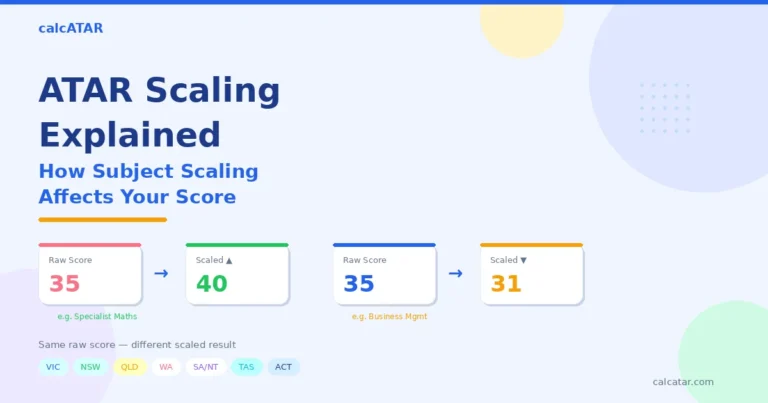
Scaling rewards strong performance in any subject. A high raw score in a “lower-scaling” subject will almost always beat a mediocre score in a “higher-scaling” one. Pick what you enjoy and can excel in.
2. Understand how your state counts subjects
Victoria counts your best 3 plus 10% of up to 7 more. NSW counts your best 10 units. Queensland counts your best 5. Knowing the formula tells you where to concentrate your effort. Read the full breakdown at How Is ATAR Calculated?
3. Use past exams as your primary study tool
Past exam papers are the closest thing to a preview of what you will face. Time yourself, check your answers against the marking guide, and identify which question types you consistently lose marks on.
4. Front-load your SAC and IA preparation
In states where internal assessments (SACs in VIC, IAs in QLD, school-assessed tasks elsewhere) contribute to your final score, these marks are locked in before exams. A strong SAC season gives you a buffer.
5. Do not neglect your weaker subjects
Your ATAR is an aggregate. Improving a weak subject from 60 to 70 often adds more to your ATAR than pushing a strong subject from 85 to 88. Diminishing returns apply at the top end.
6. Form a study group for your hardest subject
Explaining a concept to someone else is one of the most effective ways to learn it. Study groups also keep you accountable and help you fill gaps you did not know you had.
7. Use an ATAR calculator to set realistic targets
Plug your estimated scores into a calculator for your state — VCE, HSC, QCE, WACE, SACE, TCE, or BSSS — and see what ATAR they produce. Then work backwards to figure out which subjects need improvement and by how much.
8. Prioritise sleep over late-night cramming
Research consistently shows that sleep consolidates memory. A well-rested brain performs better in exams than an exhausted one that studied for two extra hours the night before.
9. Know the marking rubric, not just the content
In essay-based subjects, the difference between a 7/10 and a 9/10 is usually structure and analysis, not knowledge. Study the rubric. Understand exactly what the examiner is looking for at each grade level.
10. Check your ATAR estimate regularly and adjust
Do not wait until November to find out where you stand. Use the ATAR Predictor after each assessment block to track your trajectory. If one subject is dragging you down, you still have time to course-correct.
Frequently Asked Questions
Final Thoughts
There is no single number that makes an ATAR “good.” An ATAR is good when it gets you where you want to go. If that means a 68 to get into teaching at a regional university, then 68 is your number. If it means a 97 for medicine at Monash, then that is the target.
What I really want you to take away is this: your ATAR is one pathway, not the only pathway. More than 30% of Australian university students enter through routes that do not depend primarily on their ATAR. If the number is not what you hoped for, read the alternative pathways section above — every option listed there is a real path that thousands of students take every year.
For a quick estimate of where you stand, use the calculator for your state: VCE · HSC · QCE · WACE · SACE · TCE · BSSS
— Daniel Mitchell, calcATAR