The ATAR is probably the most misunderstood number in Australian education. Most students think it is a score out of 100. It is not. Most think every state calculates it the same way. They do not. And most have no idea what “scaling” actually does to their marks — which is a problem, because scaling is the single biggest factor that determines whether your ATAR ends up higher or lower than you expect.
I have written this guide to explain exactly how your ATAR is calculated, in plain language, for every state and territory in Australia. No jargon walls. No vague hand-waving about “statistical processes.” Just the actual mechanics — what goes in, what comes out, and why.
In This Article
- What Does Your ATAR Actually Measure?
- The General ATAR Calculation Process
- What Is Scaling and Why Does It Matter?
- Victoria (VCE) — How ATAR Is Calculated
- New South Wales (HSC) — How ATAR Is Calculated
- Queensland (QCE) — How ATAR Is Calculated
- Western Australia (WACE) — How ATAR Is Calculated
- South Australia & NT (SACE/NTCET) — How ATAR Is Calculated
- Tasmania (TCE) — How ATAR Is Calculated
- ACT (BSSS) — How ATAR Is Calculated
- State-by-State Comparison Table
- 5 Common ATAR Myths — Busted
- How to Estimate Your ATAR Before Results Day
- 10 Tips to Maximise Your ATAR
- Frequently Asked Questions
What Does Your ATAR Actually Measure?
Your Australian Tertiary Admission Rank (ATAR) is a percentile rank that tells universities where you sit relative to your entire Year 12 age cohort — including people who did not complete Year 12 or chose a non-ATAR pathway. An ATAR of 85.00 means you performed as well as or better than 85% of that population.
It is not a score out of 100. It is not a percentage. It is a rank. This distinction matters because two students with identical raw marks can end up with different ATARs depending on how the rest of the cohort performed that year, which subjects they chose, and which state they are in.
The maximum ATAR is 99.95 (not 100 — nobody gets the absolute top). The minimum reportable ATAR is 0.00, though most admissions centres do not report below 30.00.
The General ATAR Calculation Process
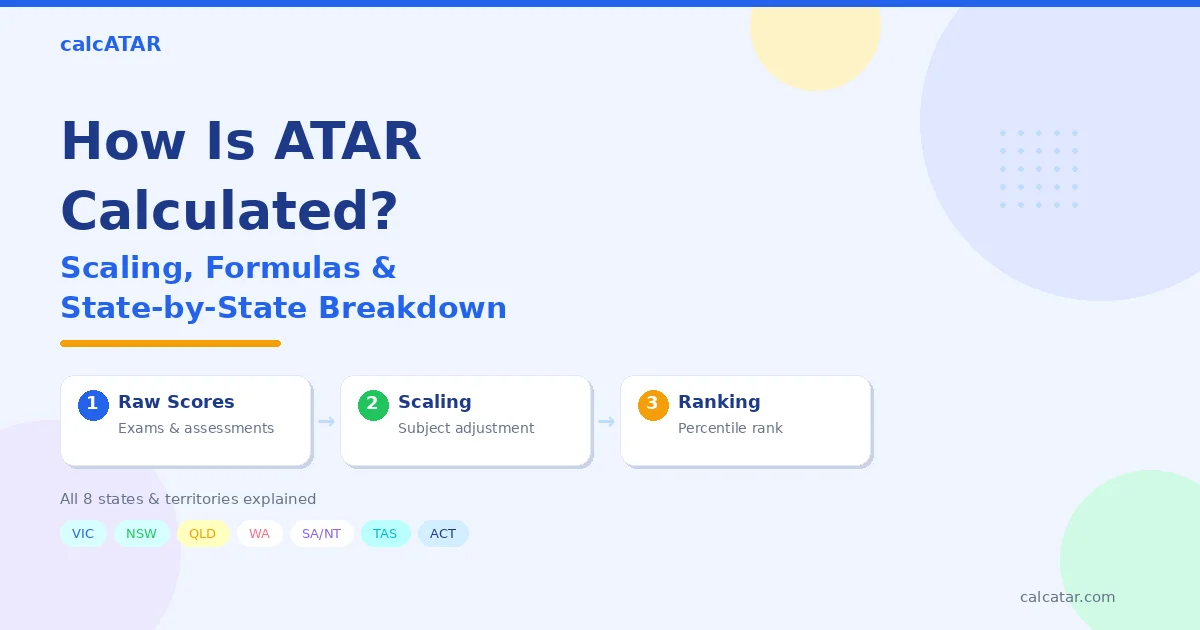
Despite every state using a different method, they all follow the same three-step logic:
- Step 1 — Get your raw results. Your exam marks and school-assessed work combine to give you a raw result for each subject. The weighting between exam and coursework varies by state.
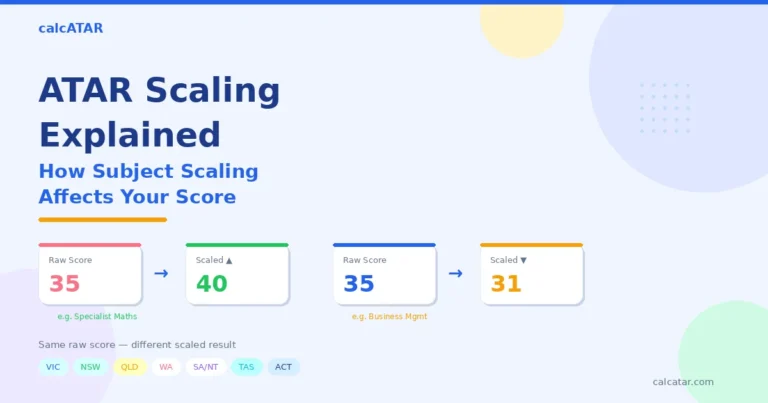
- Step 2 — Scale your results. Each state’s admissions centre (VTAC, UAC, QTAC, TISC, SATAC, or TASC) adjusts your raw marks using scaling. Scaling compares how students in each subject performed across all their other subjects. If Chemistry students tend to do well in everything else, Chemistry scores get scaled up. If a subject’s cohort underperforms elsewhere, its scores get scaled down.
- Step 3 — Build an aggregate and rank it. Your best scaled scores are combined into a single number (the aggregate), using rules that vary by state. That aggregate is then ranked against every other ATAR-eligible student in your state — and the percentile position is your ATAR.
Simple enough in theory. The complication is that every state defines “best scaled scores” differently, uses different aggregation rules, and draws the cohort boundary in slightly different places. That is what the state-by-state sections below explain.
What Is Scaling and Why Does It Matter?
Scaling is the part that makes students anxious — and the part that most explainers get wrong. Here is the short version:
Scaling does not measure subject difficulty. It measures cohort strength — how well the students in a particular subject performed across all their other subjects. Think of it like this: if the students who take Physics also tend to score highly in everything else, the Physics cohort is academically strong. Scaling reflects that strength by adjusting Physics scores upward.
The reverse is also true. If a subject attracts a cohort that performs below average in their other subjects, its scores adjust downward. This happens regardless of how “hard” the subject content is.
Scaling factors change every year because the cohort changes every year. Last year’s scaling data is a guide, not a guarantee. Use the ATAR Scaling Calculator to compare how subjects scale across states.
Victoria (VCE) — How ATAR Is Calculated
Victoria’s system is managed by VTAC (Victorian Tertiary Admissions Centre). Here is how it works:
Study Scores
For each Unit 3–4 subject, VCAA calculates a Study Score out of 50. This combines your exam result and your school-assessed coursework (SACs), with the SAC component moderated against exam performance. A Study Score of 30 is roughly the middle of the pack — not the median, but the score a student performing at the expected standard achieves.
Scaling
VTAC takes your raw Study Scores and scales them. After scaling, some subjects’ scores go up, others go down, and some barely move. The scaled Study Scores are what feed into your aggregate.
The Aggregate Formula
Your ATAR aggregate uses:
- Your best English result (English, EAL, English Language, or Literature) — counted at 100%
- Your next 3 best scaled Study Scores — counted at 100%
- Up to 2 more scaled Study Scores — counted at 10% each
Worked Example (VCE)
Say your scaled Study Scores are: English 35, Methods 38, Chemistry 33, Psychology 36, Biology 30, Legal Studies 28.
Primary four (100%): 35 + 38 + 36 + 33 = 142.0
5th subject at 10%: 30 × 0.10 = 3.0
6th subject at 10%: 28 × 0.10 = 2.8
Aggregate = 142.0 + 3.0 + 2.8 = 147.8
This aggregate is then ranked against all VCE students to determine your ATAR.
The maximum possible aggregate is around 210 (if you scored 50 in everything), but aggregates above 190 are extremely rare. An aggregate of roughly 140–145 typically converts to an ATAR around 90.
Test your own numbers with the VCE ATAR Calculator.
New South Wales (HSC) — How ATAR Is Calculated
NSW uses UAC (Universities Admissions Centre). The system is built around units of credit rather than subjects.
Units and Courses
Most HSC courses are worth 2 units. Extension courses are 1 unit. To be eligible for an ATAR, you need at least 10 units from ATAR-eligible courses, including at least 2 units of English.
The Aggregate Formula
UAC takes your best 10 units, which must include:
- Your best 2 units of English (from English Standard, Advanced, Extension 1, or Extension 2)
- Your best 8 units from remaining courses
Each unit’s HSC mark is scaled by UAC. Scaled marks for 2-unit courses can go above 50 (the raw maximum for one unit) if the cohort is strong. The maximum aggregate is 500.
Category A and B
There is a restriction: you can include a maximum of 2 units from Category B courses (VET and some workplace courses) in your ATAR. The rest must be Category A (standard academic courses).
Estimate your HSC-based ATAR with the HSC ATAR Calculator.
Queensland (QCE) — How ATAR Is Calculated
Queensland’s system is managed by QTAC. It was overhauled in 2020, replacing the old OP system with the ATAR.
Eligibility
To get an ATAR in Queensland, you need one of these combinations:
- 5 General subjects, OR
- 4 General subjects + 1 Applied subject, OR
- 4 General subjects + 1 VET qualification at Certificate III or higher
English is compulsory for QCE completion but — and this surprises many students — it does not have to be in your ATAR calculation if you have five other qualifying subjects that produce a better aggregate.
The Aggregate
QTAC uses your best 5 subject results after inter-subject scaling. The scaling method compares each subject’s cohort against all other cohorts, similar in principle to other states but using Queensland’s own data set.
Try the QCE ATAR Calculator.
Western Australia (WACE) — How ATAR Is Calculated
WA uses TISC (Tertiary Institutions Service Centre). The WACE system has a unique feature: bonus points for specific subjects.
TEA — Tertiary Entrance Aggregate
TISC calculates your Tertiary Entrance Aggregate (TEA) from:
- Your best 4 ATAR-course scaled scores
- Plus a LOTE bonus: 10% of your best Language Other Than English scaled score (even if LOTE is not in your top 4)
- Plus a Mathematics bonus: 10% of your Mathematics Methods and/or Specialist Mathematics scaled scores (even if not in your top 4)
The maximum TEA is 430. Your TEA is then converted to an ATAR using a table that TISC publishes each year.
Worked Example (WACE)
Best 4 scaled scores: English 75, Chemistry 72, Physics 68, Human Biology 65 = 280
Maths Methods scaled score: 60 → bonus = 60 × 0.10 = 6.0
No LOTE studied → LOTE bonus = 0
TEA = 280 + 6 = 286.0
Run your numbers with the WACE ATAR Calculator.
South Australia & Northern Territory (SACE/NTCET) — How ATAR Is Calculated
SA and NT share the same system, managed by SATAC. It is based on credits rather than subjects.
Credit Requirements
To qualify for an ATAR, you need at least 90 credits of study in Tertiary Admissions Subjects (TAS) and Recognised Studies at Stage 2. At least 60 of those 90 credits must come from 20-credit TAS or valid subject pairs.
The University Aggregate
SATAC builds your university aggregate from your best 90 credits:
- Three 20-credit TAS (60 credits) — counted in full
- The best result from your flexible option (30 credits) — which can be a fourth 20-credit TAS plus a 10-credit subject, or other approved combinations
Each subject gets a scaled score (up to 20.0 for a 20-credit subject, up to 10.0 for a 10-credit subject). The aggregate is then ranked to produce your ATAR.
Estimate with the SACE ATAR Calculator.
Tasmania (TCE) — How ATAR Is Calculated
Tasmania’s system is managed by TASC (Tasmanian Assessment, Standards and Certification) with UTAS handling the ATAR conversion.
The Aggregate
Your ATAR is based on your best 5 pre-tertiary subject results, with at least 3 coming from your final year of study. Subjects are scaled to reflect cohort strength, similar to other states.
The Tertiary Entrance Score (TES) is out of 75 (15 per subject × 5 subjects). The TES is then ranked against all TCE students to produce your ATAR.
Tasmania has the smallest ATAR cohort of any state, which means individual results can shift your ATAR more than they would in a larger state like Victoria or NSW.
Try the TCE ATAR Calculator.
ACT (BSSS) — How ATAR Is Calculated
The ACT uses BSSS (Board of Senior Secondary Studies) for assessment and UAC for ATAR calculation. The ACT is the only territory where UAC handles the ATAR for a non-NSW jurisdiction.
The AST
A key component is the Australian Scaling Test (AST), a general aptitude test that all ATAR-eligible ACT students sit. The AST is used to moderate (scale) your course scores — similar in purpose to the GAT in Victoria, but it plays a more central role in the ACT system.
The Aggregate
Your ATAR aggregate uses:
- Your best 3 major (T) course scores — counted at 100%
- Plus your next best course score — counted at 60% (effectively 0.6 of a standard unit)
This gives the ACT system its distinctive “3 + 0.6” structure. The aggregate is ranked to produce your ATAR.
Estimate with the ACT ATAR Calculator.
State-by-State ATAR Comparison Table
Every state reaches the same endpoint (a percentile rank from 0.00 to 99.95) but takes a completely different route to get there. Here is the full comparison:
| Feature | VIC | NSW | QLD | WA | SA/NT | TAS | ACT |
|---|---|---|---|---|---|---|---|
| Certificate | VCE | HSC | QCE | WACE | SACE/NTCET | TCE | BSSS |
| ATAR body | VTAC | UAC | QTAC | TISC | SATAC | UTAS | UAC |
| Aggregate method | Best 4 + 10% of 5th/6th | Best 10 units | Best 5 subjects | Best 4 + bonuses | Best 90 credits | Best 5 subjects | Best 3 + 0.6 of 4th |
| Max aggregate | ~210 | 500 | N/A | 430 | ~90 | 75 | N/A |
| English compulsory in ATAR? | Yes (must be in primary 4) | Yes (2 units minimum) | No* | No* | No* | No* | No* |
| Subject bonuses | No | No | No | Yes (LOTE + Maths) | No | No | No |
| Moderation test | GAT | — | — | — | — | — | AST |
| Calculator | VCE | HSC | QCE | WACE | SACE | TCE | BSSS |
*English is compulsory for certificate completion in most states but may not be required in the ATAR aggregate calculation itself if other qualifying subjects produce a higher result.
5 Common ATAR Myths — Busted
Myth 1: “My ATAR is a percentage — an 80 means I scored 80%”
No. Your ATAR is a percentile rank. An ATAR of 80.00 means you performed better than 80% of your age cohort. It has nothing to do with your raw marks as a percentage. A student with an average raw mark of 75% might get an ATAR of 85 or 65 depending on their subjects, their state, and their cohort.
Myth 2: “English counts more than other subjects”
In Victoria, yes — English (or an English equivalent) must be one of your primary four subjects. But it does not get a higher weighting. It counts at the same 100% as your other three best subjects. In most other states, English is required for certificate completion but does not have to be in your ATAR calculation if you have better results elsewhere. English does not magically count for more. It is just compulsory.
Myth 3: “I should pick high-scaling subjects to get a better ATAR”
This is the most dangerous myth. Scaling rewards cohort strength, and high-scaling subjects tend to have very competitive cohorts. If you scrape a 25 in Specialist Mathematics (a high-scaling subject), you will almost certainly end up worse off than if you had scored a 40 in a lower-scaling subject. I really suggest picking subjects you will excel in. A high raw score in any subject almost always beats a mediocre score in a “prestigious” one.
Myth 4: “You need a 90+ ATAR to get into university”
The majority of undergraduate courses have cutoffs below 80. Many excellent programs — nursing, education, business, creative arts, IT — regularly have cutoffs in the 60s and 70s. A 90+ ATAR opens doors to competitive courses like medicine, law, and engineering at sandstone universities, but it is not a requirement for university in general. Not even close.
Myth 5: “The ATAR system is the same across Australia”
As the comparison table above shows, every state has a different aggregate method, different weighting rules, and different admissions bodies. The final ATAR is nationally comparable (an 85 in Victoria is equivalent to an 85 in NSW for interstate applications), but the process to get there is completely different. That is why each state needs its own calculator.
How to Estimate Your ATAR Before Results Day
You do not need to wait until December to have a rough idea of where you stand. Here are three ways:
1. Use your state’s ATAR calculator. calcATAR has a dedicated calculator for every state: VCE, HSC, QCE, WACE, SACE, TCE, BSSS. Enter your expected scores and get a projected ATAR using real scaling data.
2. Use the quick estimator. If you do not want to pick specific subjects, the ATAR Predictor gives you a ballpark range in about 30 seconds — just enter your expected average and difficulty level.
3. Compare scaling effects. The ATAR Scaling Calculator shows you how switching one subject for another would change your projected ATAR. This is especially useful if you are still choosing subjects for next year.
10 Tips to Maximise Your ATAR
1. Pick subjects you will score well in — not subjects that “scale well”
I keep coming back to this because it is the most common mistake. A raw score of 42 in Food Technology will contribute more to your aggregate than a raw score of 28 in Specialist Maths, despite the scaling difference. The maths is unambiguous on this.
2. Lift your weakest primary subject first
Your weakest subject in your top four (or top 10 units in NSW) drags down your entire aggregate at 100%. Improving a weak subject from 28 to 34 is worth more than improving a strong subject from 38 to 42 — the effort-to-ATAR return is higher.
3. Do not neglect the GAT (VIC) or AST (ACT)
These moderation tests do not count directly toward your ATAR, but they are used to moderate your school-assessed work. A strong GAT or AST performance protects your SAC/coursework scores during the moderation process. A weak one can pull them down. Treat it seriously.
4. Do more subjects than the minimum if you can manage it
In Victoria, doing 6 subjects instead of 5 gives you two incremental contributions at 10% instead of one. In NSW, doing 12 units instead of 10 means your two weakest units drop off. Extra subjects are insurance — your worst result disappears.
5. Understand your state’s specific aggregation rules
The details matter. In WA, studying a LOTE or Methods/Specialist gives you bonus points even if those subjects are not your best four. In SA, the flexible option (your fourth 20-credit TAS plus a 10-credit subject) can be a strategic choice. Know your state’s rules — read the relevant section above.
6. Use past exams properly
Past exams are the highest-value study resource available. Do them under timed conditions, mark them using the published marking guide, and analyse which question types you consistently lose marks on. Then study those weak points specifically. Most students just “do past papers” without the analysis step — that is half the value wasted.
7. Do not burn out in Term 3
I talk to students every year who study 10+ hours a day in September and arrive at the exam period completely exhausted. Sustainable study across the year beats a frantic sprint. Your brain needs rest to consolidate information — this is neuroscience, not opinion.
8. Get your SACs/coursework right the first time
School-assessed components typically make up 30–50% of your final result (varies by state and subject). They are also the part you have the most control over, because you do them in familiar conditions with known deadlines. A student who aces their coursework and has an average exam still ends up ahead of a student who scraped through coursework and had a good exam.
9. Check whether your preferred course uses selection ranks, not just ATAR
Some university courses add adjustment points (for equity, subject prerequisites, portfolios, or regional access) on top of your ATAR. This means your “effective” rank might be higher than your raw ATAR. Check the specific course on your admissions centre’s website — you might be closer to the cutoff than you think.
10. Run your numbers early and often
Plug your estimated scores into the calculator for your state after every major assessment. Watching your projected ATAR move over the year gives you a feedback loop — you will know which subjects need more work and which are tracking fine. This is free and takes two minutes.
Frequently Asked Questions
Final Thoughts
The ATAR calculation looks complicated — and honestly, it is. Every state does it differently, the scaling formulas are not public, and the whole thing feels opaque from the outside. But the core logic is simpler than it seems: do well in your subjects, and scaling takes care of the rest.
If you want to see where you stand before results day, use the calculator for your state: VCE · HSC · QCE · WACE · SACE · TCE · BSSS. Or try the ATAR Predictor for a quick 30-second estimate.
— Daniel Mitchell, calcATAR