📖 Table of Contents
- Understand How ATAR Actually Works
- Choose Your Subjects Strategically
- Study Smarter, Not Harder
- Master Exam Technique
- Manage Your Time and Routine
- Take Care of Your Health
- Use Every Resource Available
- Realistic Improvement: What’s Possible
- State-Specific Tips
- 10 Tips Summary
- Frequently Asked Questions
Your ATAR is not fixed. It is the product of decisions you make right now — which subjects you take, how you study, how you handle exams, and how you manage yourself across the year. Students who improve their ATAR significantly do not just “try harder.” They change their approach.
This guide covers the specific, actionable strategies that actually move the needle — from subject selection and study methods backed by cognitive science to exam technique, time management, and state-specific tips. Whether you are aiming for a 70, a 90, or a 99, the principles are the same. The execution just gets tighter.
Understand How ATAR Actually Works
Before you can improve your ATAR, you need to understand what it actually is — and what it is not.
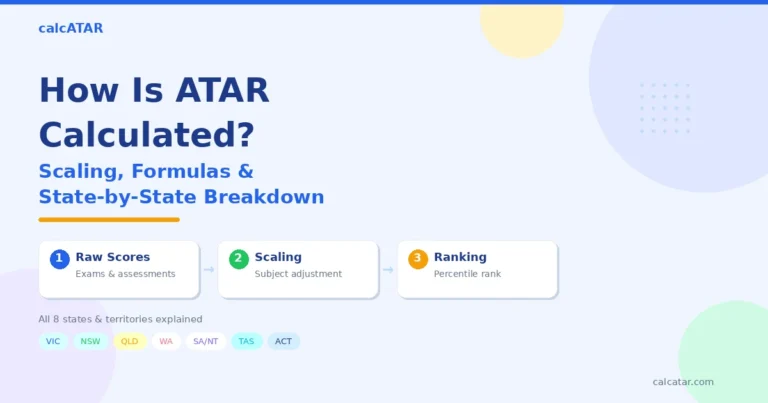
Your ATAR is a percentile rank, not a score. An ATAR of 85.00 means you performed better than 85% of the Year 12 cohort in your state. It is not your average mark. It is not a percentage. It is a rank based on your scaled subject results compared to every other student.
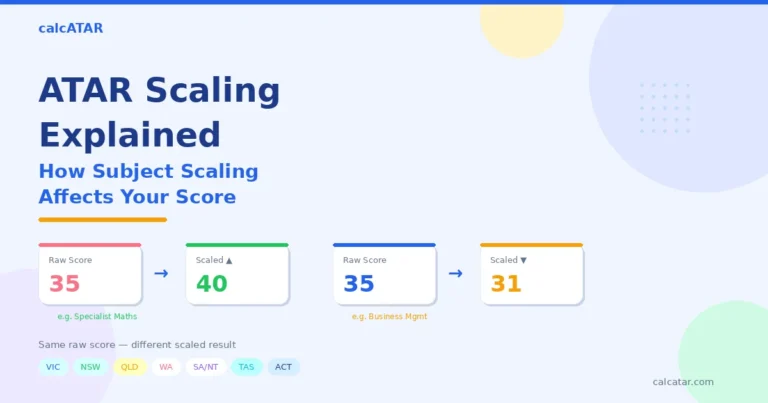
This distinction matters because it changes how you think about improvement. You do not need to get higher raw marks in every subject — you need to outperform more students relative to the cohort. Sometimes that means a 5-mark improvement in a high-scaling subject is worth more than a 15-mark improvement in a low-scaling one.
Why This Gives You an Advantage
Most students study harder without studying smarter. They put in more hours without understanding how ATAR is calculated, how scaling works, or which improvements will actually move their rank. If you understand the system, you can make strategic decisions that multiply the value of every hour you study.
For example: if you are averaging a B in Physics (which scales up significantly) and an A in a low-scaling subject, spending your extra study hours lifting Physics to a B+ will likely improve your ATAR more than pushing your A to an A+. Use the Scaling Comparison Tool to see how different subjects scale in your state.
Choose Your Subjects Strategically
Subject selection is the single biggest decision you make before Year 12 starts. Get it right and you build an ATAR advantage before you sit a single exam. Get it wrong and you spend the year fighting an uphill battle.
Passion + Strength Beats Gaming the System
The most common mistake students make is choosing subjects purely because they “scale well.” If you pick a subject you hate or struggle with just because it has high scaling, you are likely to get a mediocre result in it — and a mediocre result in a high-scaling subject can contribute less to your ATAR than a strong result in a lower-scaling one.
The formula is simple: pick subjects where you are strong AND interested. If those subjects also happen to scale well, that is a bonus. But strength and engagement always come first.
| Common Mistake | What Happens | What to Do Instead |
|---|---|---|
| Picking a subject only because it scales well | You struggle, get a mediocre result, and the scaling does not save you | Pick subjects where you consistently get strong results AND enjoy the content |
| Dropping a subject you are strong at because it “scales badly” | You lose a reliable contributor to your ATAR | Keep it — a strong result in any subject beats a weak result in a “hard” one |
| Taking too many subjects to hedge | You spread yourself thin and perform worse across all of them | Focus on quality in 5–6 subjects (your state’s best-N rule means extras are insurance, not the strategy) |
| Following friends into subjects | Their strengths are not yours — you end up in the wrong class | Choose based on YOUR results and interests, not peer pressure |
| Ignoring prerequisites | You miss a university requirement and have to do a bridging course | Check ATAR requirements for courses before locking in subjects |
Study Smarter, Not Harder
The difference between students who get an 80 and students who get a 95 is not the number of hours they study. It is how they study. Cognitive science has identified which study techniques actually produce durable learning — and which are a waste of time.
Effective vs Ineffective Study Methods
| Technique | How It Works | Effectiveness |
|---|---|---|
| Active recall | Close your notes. Try to write down or explain everything you know about a topic from memory. Check what you missed. | 🟢 Extremely high — forces your brain to retrieve information, which strengthens memory |
| Spaced repetition | Review material at increasing intervals — 1 day, 3 days, 7 days, 14 days. Use flashcards (Anki) or a revision calendar. | 🟢 Extremely high — fights the forgetting curve |
| Practice exams (timed) | Do full past papers under exam conditions. Time yourself. Mark yourself using the official marking guide. | 🟢 Very high — builds exam stamina and reveals gaps |
| Interleaving | Mix different topics or question types in one study session instead of blocking one topic at a time. | 🟡 High — harder in the moment but produces better long-term retention |
| Re-reading notes | Reading through your notes or textbook highlights again and again. | 🔴 Low — feels productive but creates an illusion of knowledge |
| Highlighting / underlining | Marking up a textbook or printout with colour. | 🔴 Very low — passive activity that does not create memory |
| Copying notes out neatly | Rewriting notes word-for-word in a nicer format. | 🔴 Low — time-consuming with minimal retention benefit |
Active Recall: The Single Most Important Technique
If you take one thing from this entire article, let it be this: active recall is the study technique that separates top ATAR students from everyone else. The idea is simple — instead of passively reading your notes, you close them and try to recall everything from memory. Then you check what you got right and what you missed.
Do this for every topic, every week. Your brain learns by retrieving information, not by re-reading it. Every time you successfully recall something, that memory gets stronger. Every time you fail to recall something, you know exactly where to focus next.
Past Papers: Where to Find Them
Past exam papers with marking guides are the closest thing to a cheat code. They show you the exact format, question style, and marking criteria examiners use. Do at least three years of past papers for every subject — under timed exam conditions.
| State | Exam Body | Where to Find Past Papers |
|---|---|---|
| VIC | VCAA | vcaa.vic.edu.au — Past Examinations |
| NSW | NESA | NESA — Past HSC Papers |
| QLD | QCAA | qcaa.qld.edu.au — Senior Subjects (sample and past assessments by subject) |
| WA | SCSA | SCSA — Past ATAR Exams |
| SA | SACE Board | sace.sa.edu.au — Subjects (past exams by subject page) |
| TAS | TASC | TASC — Past Exams |
Master Exam Technique
Knowing the content is necessary. Knowing how to translate that content into marks under exam conditions is what separates an 85 from a 95. Exam technique is a learnable skill — and most students never practise it deliberately.
Time Management: The Minutes-Per-Mark Rule
Divide your total writing time by the total marks available. If a 3-hour exam is worth 100 marks, you have roughly 1.8 minutes per mark. A 6-mark question gets ~11 minutes. A 20-mark essay gets ~36 minutes. Stick to this ruthlessly. The students who run out of time are the ones who over-invest in early questions and leave high-value questions unanswered at the end.
Exam Command Words
Every exam question contains a command word that tells you exactly what the examiner wants. Misreading it is one of the most common causes of lost marks.
| Command Word | What It Actually Means | Common Mistake |
|---|---|---|
| Identify / State | Name it. One sentence. No explanation needed. | Writing a paragraph when a single sentence would score full marks |
| Describe | Give a detailed account of what something is or how it works | Confusing with “explain” — describe is about WHAT, not WHY |
| Explain | State the point AND give the reason or mechanism behind it | Describing without giving the reason — missing the “because” |
| Analyse | Break it into parts. Examine how the parts relate. Show cause and effect. | Simply describing the topic without breaking it down or showing relationships |
| Evaluate | Make a judgement. Weigh the evidence for and against. Reach a conclusion. | Listing points without making a clear judgement at the end |
| Compare | Show similarities AND differences between two or more things | Only discussing one side — you need both similarities and differences |
| Discuss | Present different perspectives or arguments. Consider strengths and weaknesses. | Giving only one viewpoint without considering alternatives |
| Justify | Give reasons or evidence that supports a position or conclusion | Describing the position without providing supporting evidence |
Answering Strategies by Question Type
- Multiple choice: Eliminate two obviously wrong answers first. Then compare the remaining two carefully. If stuck, go with your first instinct — research shows it is more often right than a changed answer.
- Short answer: Answer the question directly in your first sentence. Then provide supporting detail. Do not bury your answer in the middle of a paragraph.
- Extended response / essay: Spend 3–5 minutes planning before writing. Write a clear thesis in your introduction. Use topic sentences to open each paragraph. End with a conclusion that directly answers the question.
- Calculation / problem-solving: Show every step of working — even if you get the final answer wrong, you can still earn method marks. Box or underline your final answer.
Manage Your Time and Routine
Create a Realistic Study Timetable
The key word is realistic. A fantasy timetable with 6 hours of study every night does not work — you will abandon it by week two and feel guilty about it. A realistic timetable accounts for school, transport, meals, exercise, and downtime.
For most Year 12 students aiming for 85+, 2 to 3 hours of focused study per school night and 4 to 6 hours on each weekend day is a sustainable baseline. Adjust up for exam periods and down during holidays (but never to zero).
The Pomodoro Technique
Study in 25-minute focused blocks followed by a 5-minute break. After four blocks, take a longer 15–20 minute break. This technique works because it matches your brain’s natural attention span and prevents the mental fatigue that comes from marathon study sessions.
During your 25 minutes: phone off (not silent — off or in another room), no social media tabs open, one subject only. During your 5-minute break: stand up, stretch, get water. Do not open your phone — it pulls you back in.
When to Start Serious Revision
| Timeline | What to Focus On |
|---|---|
| Start of Year 12 | Build a foundation of consistent daily study. Stay on top of school assessments. Begin active recall for each topic as you learn it. |
| Mid-Year (Term 2–3) | Identify your weakest topics. Start doing past papers. Adjust subject selection if you have not locked in. |
| 6 Weeks Before Exams | Full revision mode. Two passes through every topic: first pass for understanding gaps, second pass for active recall and practice exams. |
| Final 2 Weeks | Past papers under timed conditions. Focus on high-value topics. Light revision only the day before each exam — no new content. |
Take Care of Your Mental and Physical Health
This section is not filler. It is one of the highest-leverage ATAR strategies that students consistently underestimate. A well-rested, physically active student with manageable stress will outperform a sleep-deprived, anxious student who studies twice as many hours.
Sleep
Aim for 7 to 9 hours every night. Sleep is when your brain consolidates what you studied during the day. Cut your sleep and you cut the effectiveness of every hour you studied. One night of bad sleep before an exam costs more marks than one night of extra study gains.
Exercise
Even 20–30 minutes of daily physical activity (a walk, a run, a gym session) improves focus, reduces stress, and boosts memory consolidation. Schedule it like a class — it is not optional downtime, it is part of your ATAR strategy.
Managing Exam Stress
Some stress is normal and even helpful — it sharpens your focus. But chronic stress or anxiety reduces your ability to recall information and think clearly. Recognise the warning signs of burnout: constant fatigue, dreading study, declining performance despite more effort, withdrawal from friends and activities. If you are experiencing these, talk to a trusted adult, your school counsellor, or your GP.
Use Every Resource Available
Free Resources
- Past papers and marking guides — available from every state exam body (table above)
- Your teachers — the most underrated resource. Ask for specific feedback on your practice responses. Teachers know the marking criteria because many of them have been examiners.
- Study groups — effective when structured (quiz each other, explain topics to each other) and counterproductive when unstructured (chatting with notes open)
- YouTube and free course content — channels like Eddie Woo (maths), Organic Chemistry Tutor, and state-specific exam walkthroughs
Paid Resources: When They Are Worth It
- Tutoring — worth it if the tutor is subject-specific, experienced with your state’s curriculum, and provides feedback on YOUR work (not just re-teaching content). Not worth it if you are already performing well and just want reassurance.
- Online courses and exam prep programs — worth it for structured revision closer to exams. Less useful early in the year when you should be building understanding through classwork.
Our Calculators
Estimate your ATAR right now with the free calculator for your state — VCE, HSC, QCE, WACE, SACE, TCE, or ACT. Run different scenarios to see how improving each subject by a few marks changes your ATAR. For a quick estimate, try the 30-Second ATAR Predictor.
Realistic ATAR Improvement: What’s Actually Possible
One of the most common questions is: “Can I actually improve my ATAR from X to Y?” The honest answer depends on where you are starting, how much time you have left, and how willing you are to change your approach — not just add more hours.
| Current Estimate | Realistic Target | What It Takes | Difficulty |
|---|---|---|---|
| 50–60 | 70–75 | Consistent daily study, active recall, past papers, fix fundamental gaps in weak subjects | 🟢 Achievable with sustained effort |
| 65–75 | 80–85 | Strategic subject focus, 2–3 hrs/night, timed practice exams, exam technique coaching | 🟢 Achievable — most students at this level have specific fixable weaknesses |
| 80–85 | 90–92 | Shift from passive to active study, master exam technique, target high-scaling subjects for improvement | 🟡 Hard but possible — requires changing HOW you study, not just how much |
| 88–92 | 95+ | Eliminate all careless errors, perfect exam timing, deep mastery of every topic, past papers until patterns are automatic | 🟡 Hard — the difference between 90 and 95 is precision, not extra content |
| 95–97 | 99+ | Elite execution across all subjects, near-perfect exam technique, strategic use of scaling, minimal mark leakage anywhere | 🔴 Very hard — requires top-10% performance in nearly every subject |
State-Specific Tips
| State | System | Key Tip | Calculator |
|---|---|---|---|
| VIC | VCE | SACs (School-Assessed Coursework) count towards your study score. Do not treat them as “just practice” — they are real assessment. GAT performance affects your derived exam score if you are absent. | VCE Calculator |
| NSW | HSC | Internal school assessments determine your school-based ranking, which is then moderated by the HSC exam. Your internal rank within your school matters as much as your external mark. | HSC Calculator |
| QLD | QCE | External exams are worth 25% for humanities/arts and 50% for maths/science. Internal assessments (IA1, IA2, IA3) make up the rest. Every IA counts — do not coast on one good exam result. | QCE Calculator |
| WA | WACE | External exams are worth exactly 50%. TISC uses your best four scaled scores (+10% of fifth). A strong fifth subject is free ATAR insurance. | WACE Calculator |
| SA/NT | SACE | Research Project is compulsory and contributes to your ATAR. Treat it seriously — an A+ in Research Project is free scaling credit. | SACE Calculator |
| TAS | TCE | Your best five external results count. Tasmania’s smaller cohort means scaling can be more volatile — strong performance in any subject is rewarded. | TCE Calculator |
| ACT | BSSS | ACT uses a moderation process based on the AST (ACT Scaling Test). Your AST score helps calibrate your school-based results against the territory cohort. | ACT Calculator |
10 Tips to Improve Your ATAR
Frequently Asked Questions
Final Thoughts
Improving your ATAR is not about working more hours — it is about working smarter on the things that actually move the needle. Choose subjects where you have genuine strength, use active recall instead of passive re-reading, do every past paper you can find under timed conditions, and take care of your body and mind along the way.
I really suggest you start by estimating your current ATAR with the 30-Second ATAR Predictor or your state calculator. That gives you a baseline. Then identify which subjects have the most room for improvement and pour your effort there. Small, consistent gains across four subjects compound into significant ATAR jumps.
You have got this. Start now.
— Daniel Mitchell, calcATAR