📖 Table of Contents
If you are completing the International Baccalaureate (IB) Diploma and planning to study at an Australian university, you need to understand how your IB score converts to an ATAR equivalent. The conversion is not a simple formula — it is a statistical mapping that changes every year based on cohort performance.
This guide covers the official 2026 conversion table, how the IB Admissions Score (IBAS) works, what each Tertiary Admissions Centre (TAC) does with your results, and which IB scores you need for competitive courses like medicine, law, and engineering. If you are still deciding between IB and your state’s ATAR pathway, we compare both systems side by side.
What is the International Baccalaureate (IB)?
The International Baccalaureate Diploma Programme (IBDP) is a two-year pre-university curriculum recognised in over 150 countries. Unlike Australian state systems (VCE, HSC, QCE, WACE, SACE), the IB is a fixed curriculum — every student worldwide sits the same subjects and exams.
How IB Scoring Works
Your IB Diploma score is calculated from three components:
- Six subjects — three at Higher Level (HL) and three at Standard Level (SL), each graded 1–7. Maximum: 42 points.
- Theory of Knowledge (TOK) + Extended Essay (EE) — combined, these contribute up to 3 bonus points.
- Maximum possible score: 45 points.
The minimum score to receive the IB Diploma is 24 points (with conditions). The worldwide average is typically around 30–31 points.
IB to ATAR Conversion Table (2026 Entry)
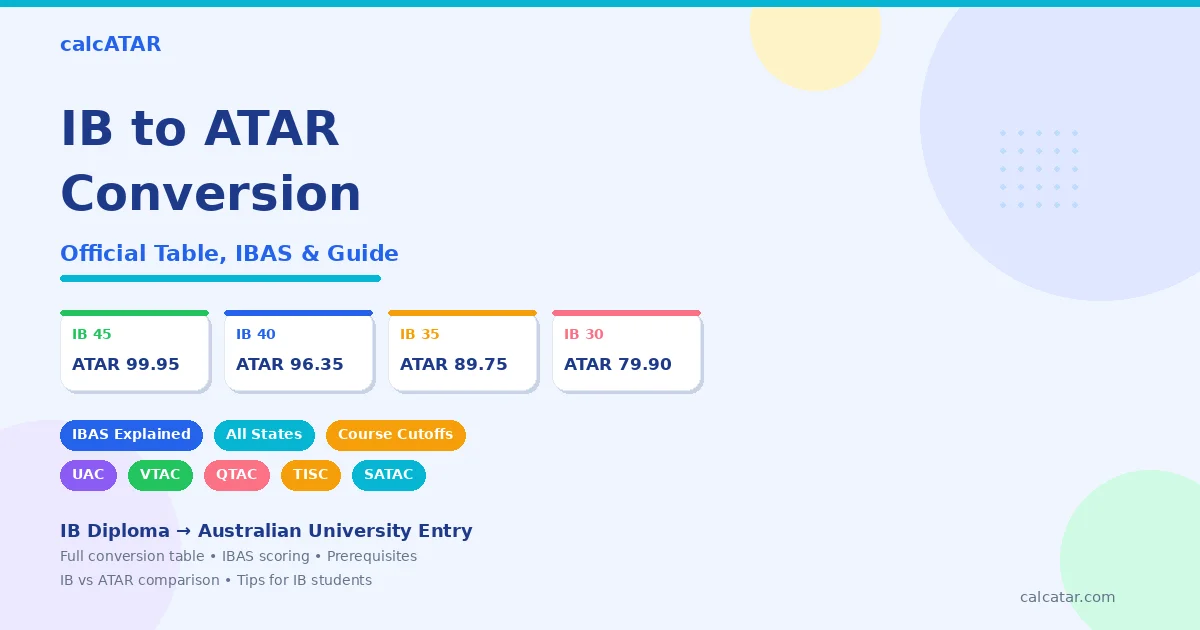
The table below shows the official conversion from IB Diploma scores to ATAR-equivalent Combined Ranks for university offers from August 2026. This schedule is calculated by ACTAC (Australasian Conference of Tertiary Admission Centres) and used by all Australian TACs — UAC, VTAC, QTAC, TISC, and SATAC.
| IB Score | ATAR Equivalent (High) | ATAR Equivalent (Low) | Competitiveness |
|---|---|---|---|
| 45 | 99.95 | 99.85 | 🏆 Top 0.05–0.15% |
| 44 | 99.75 | 99.50 | 🏆 Top 0.25–0.50% |
| 43 | 99.35 | 98.90 | 🏆 Top 0.65–1.10% |
| 42 | 98.75 | 98.20 | Medicine, top law |
| 41 | 98.00 | 97.30 | Competitive law, dentistry |
| 40 | 97.05 | 96.30 | Law, pharmacy, advanced science |
| 39 | 96.00 | 95.25 | Most Go8 courses |
| 38 | 95.00 | 94.25 | Engineering, commerce (Go8) |
| 37 | 93.95 | 93.00 | Competitive programs |
| 36 | 92.65 | 91.45 | Engineering, allied health |
| 35 | 91.05 | 89.75 | 90+ ATAR zone |
| 34 | 89.30 | 88.15 | Most university programs |
| 33 | 87.80 | 86.20 | Science, business, IT |
| 32 | 85.55 | 84.00 | Broad university access |
| 31 | 83.55 | 82.00 | Education, arts, social science |
| 30 | 81.45 | 79.90 | World average zone |
| 29 | 79.35 | 77.65 | Many degree programs |
| 28 | 77.05 | 75.20 | Nursing, social work |
| 27 | 74.55 | 72.65 | Arts, humanities |
| 26 | 72.00 | 69.75 | Some regional programs |
| 25 | 68.90 | 66.90 | Limited entry programs |
| 24 | 66.30 | 64.25 | Minimum diploma — pathway options |
How is IB Converted to ATAR?
IB students do not receive an ATAR directly. Your IB results are converted to an ATAR-equivalent Combined Rank by the Tertiary Admissions Centre (TAC) in your state. The conversion is coordinated nationally by ACTAC, so the same table applies across all states — but each TAC handles the process slightly differently.
State-by-State Process
| State/Territory | TAC | How It Works for IB Students |
|---|---|---|
| NSW & ACT | UAC | Automatic if you grant permission through your school. UAC receives your IB results and calculates your Combined Rank using the IBAS. You can also apply for subject adjustment factors. |
| Victoria | VTAC | VTAC receives your results and may calculate a Derived IB Rank. Register through VTAC and ensure your IB school releases results. |
| Queensland | QTAC | Apply through QTAC. Your IB score converts to an ATAR equivalent using the national ACTAC table. Some universities accept IB directly. |
| Western Australia | TISC | Apply through TISC. Your Combined Rank is calculated from the ACTAC conversion. Some UWA pathways accept IB directly. |
| SA & NT | SATAC | Apply through SATAC. The ACTAC conversion applies. University of Adelaide offers credit for higher-level IB subjects. |
| Tasmania | UTAS direct | University of Tasmania accepts IB applications directly. Contact UTAS admissions for conversion details. |
What is the IBAS (IB Admissions Score)?
Since November 2022, Australian students sitting the IB receive an IB Admissions Score (IBAS) alongside their regular IB score. The IBAS adds decimal precision — 0.25, 0.50, or 0.75 — to your whole-number score, creating a finer-grained ranking.
How the IBAS is Calculated
ACTAC looks at where you sit within each grade band across your six subjects. Two students with the same IB total (say, 38) can receive different IBAS values — 38.25 vs 38.75 — based on how strongly they performed within their subject-level grades. The student at the top of multiple grade bands gets a higher IBAS.
Worked Example
| Detail | Student A | Student B |
|---|---|---|
| IB Diploma Score | 38 | 38 |
| IBAS | 38.75 | 38.25 |
| Combined Rank | ~95.00 | ~94.25 |
| Difference | 0.75 ATAR points — enough to change a course offer | |
IB vs ATAR: Key Differences
The IB and ATAR are fundamentally different systems. Understanding the differences helps you make sense of the conversion and choose the right pathway.
| Feature | IB Diploma | ATAR |
|---|---|---|
| What it measures | Curriculum-based achievement (how well you learned the content) | Percentile rank (your position relative to other students) |
| Maximum | 45 points | 99.95 |
| Subjects required | 6 (3 HL + 3 SL) — mandatory | 4–6 depending on state |
| Subject choice | Fixed groups — must take one from each of 6 areas | Open — choose from state offerings |
| Assessment | Internal assessments (20–30%) + external exams (70–80%) | Varies by state (VCE: 50% SAC + 50% exam, HSC: 50/50, QCE: 25/75, etc.) |
| Bonus components | TOK + Extended Essay = up to 3 extra points | No bonus points in the ATAR itself |
| Scaling | No individual subject scaling — score is absolute | Subjects are statistically scaled before ATAR calculation |
| Recognition | International — accepted in 150+ countries | Australia only |
| Curriculum | Same worldwide | Different per state (VCE, HSC, QCE, WACE, SACE) |
Which IB Score Do You Need for Popular Courses?
The table below shows typical IB scores needed for competitive courses at Group of Eight (Go8) universities, alongside the ATAR equivalents. These are indicative — cutoffs change yearly and some courses have interviews, aptitude tests, or prerequisite subjects on top of the score.
| Course | IB Score Needed | ATAR Equivalent | Notes |
|---|---|---|---|
| Medicine (undergrad) | 43–45 | 99.0–99.95 | Plus UCAT and interview. HL Chemistry or Biology often required. |
| Law (Go8) | 40–42 | 96.30–98.75 | Some accept 38+ combined with portfolio or test scores. |
| Dentistry | 40–43 | 96.30–99.35 | HL Chemistry or Biology usually prerequisite. |
| Engineering (Go8) | 36–38 | 91.45–95.00 | HL Maths required. Physics HL recommended. |
| Commerce / Business (Go8) | 36–38 | 91.45–95.00 | Maths at SL or HL. Lower at non-Go8 universities. |
| Science (Go8) | 34–36 | 88.15–92.65 | HL in relevant science subject (Chemistry, Physics, Biology). |
| Pharmacy | 35–38 | 89.75–95.00 | HL Chemistry usually required. |
| Nursing | 28–32 | 75.20–85.55 | Some universities require HL Biology or Chemistry. |
| Education / Teaching | 27–30 | 72.65–81.45 | Literacy and numeracy test (LANTITE) also required. |
| Arts / Humanities | 25–30 | 66.90–81.45 | Broad entry. Some Go8 programs need 34+. |
Do Australian Universities Accept IB Scores?
Yes — every Australian university accepts the IB Diploma for undergraduate admission. The IB is treated as equivalent to an Australian Year 12 qualification, and your score is converted to a Combined Rank (ATAR equivalent) through the ACTAC conversion table.
How to Apply as an IB Student
You apply through the same TAC that handles all university applications in your state: UAC (NSW/ACT), VTAC (VIC), QTAC (QLD), TISC (WA), or SATAC (SA/NT). Register on their website, select “IB Diploma” as your qualification, list your preferences, and ensure your school releases your results to the TAC.
Prerequisites: Higher Level vs Standard Level
Australian universities distinguish between HL and SL when setting prerequisites. Most STEM courses require specific HL subjects. A few key rules:
- HL subjects are generally treated as equivalent to a state’s highest-level course (e.g., VCE Units 3 & 4, HSC Band 5–6 equivalent).
- SL subjects may meet general prerequisites but often do not satisfy prerequisite requirements for competitive STEM programs.
- Some Go8 universities grant course credit for HL subjects scored at 6 or 7 — effectively skipping first-year units (University of Adelaide, University of Queensland, and others offer this).
Adjustment Factors and Bonus Points
IB students are eligible for the same adjustment factors (equity, school, location) that domestic ATAR students receive. In NSW, UAC applies subject adjustment factors automatically if you grant permission. In Victoria, VTAC may apply Access Melbourne or similar schemes. Check your specific TAC for details — these can add 1–5 points to your Combined Rank and make a real difference.
IB vs Choosing an ATAR Pathway: Which is Better?
If your school offers both the IB and the local ATAR pathway (VCE, HSC, etc.), the choice depends on your goals, strengths, and what you value in your final two years.
| Factor | IB Diploma | State ATAR Pathway |
|---|---|---|
| Subject flexibility | ❌ Limited — must take one from each of 6 groups (Language, Sciences, Maths, Humanities, Arts, second language) | ✅ Open — choose any combination from your state’s list |
| Workload | Higher — 6 subjects + TOK + Extended Essay + CAS | Moderate — typically 5–6 subjects, no mandatory essay or service |
| Scaling advantage | None — no individual subject scaling. Your total converts as one number. | Possible — strategic subject selection can boost your scaled score |
| International mobility | ✅ Strong — recognised by universities worldwide | ❌ Limited — ATAR is recognised primarily in Australia |
| Critical thinking focus | ✅ Extensive — TOK and Extended Essay develop research and philosophy skills | Varies — depends on subject selection |
| University credit | ✅ Some unis grant credit for HL 6 or 7 | Rarely — some accelerated pathway exceptions |
| Conversion risk | Your ATAR equivalent changes yearly — you can’t predict it precisely | Direct ATAR — no conversion needed |
| Best for | Students who want broad education, international options, or are strong across all subject areas | Students who want to specialise, leverage scaling, or target a specific ATAR |
Tips for IB Students Applying to Australian Universities
Frequently Asked Questions
Final Thoughts
The IB to ATAR conversion is not as mysterious as it seems. Your IB Diploma score — including the bonus TOK and Extended Essay points — converts to an ATAR-equivalent Combined Rank through a national ACTAC table that every Australian TAC uses. The IBAS adds decimal precision for students who sat the IB in Australia since November 2022, so your position within grade bands genuinely matters.
I really suggest you focus on three things: maximise your IB total (every point moves the ATAR needle), confirm your HL subjects meet prerequisites for your target courses, and register early with your state’s TAC so your results flow through automatically. After results drop in December, use the change of preference window to lock in your best options based on your actual Combined Rank.
Estimate your ATAR from any state system using our 30-Second ATAR Predictor, or compare scaling across subjects with the Scaling Comparison Tool.
— Daniel Mitchell, calcATAR