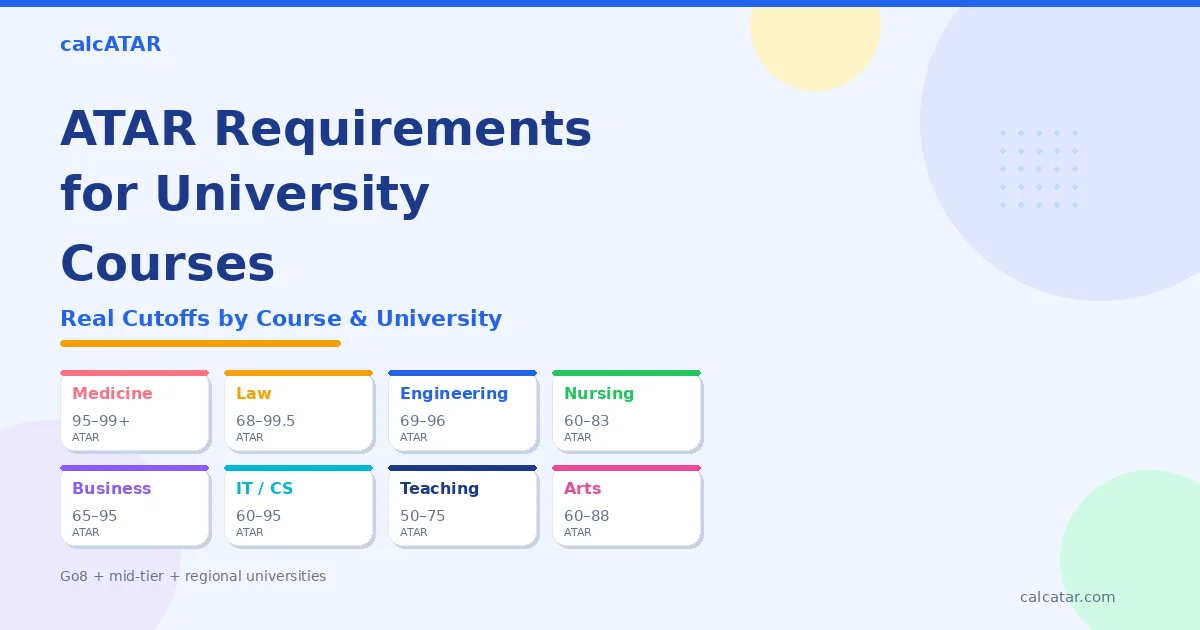
Every Year 12 student asks the same question: What ATAR do I need to get into my course? The answer depends on the university, the course, the year, and sometimes the state you live in. This guide compiles real ATAR cutoffs for the most popular undergraduate courses across Australian universities — from medicine and law to nursing and IT — so you can see exactly where you stand and what you need to aim for.
Use this page alongside the free ATAR calculator for your state (VCE, HSC, QCE, WACE, SACE, TCE, BSSS) to estimate your current ATAR and compare it against your target course.
📋 Table of Contents
- How ATAR Cutoffs Work
- Medicine ATAR Requirements
- Law ATAR Requirements
- Engineering ATAR Requirements
- Nursing ATAR Requirements
- Business & Commerce ATAR Requirements
- Arts & Humanities ATAR Requirements
- Teaching & Education ATAR Requirements
- IT & Computer Science ATAR Requirements
- Lowest ATAR to Get Into University
- Courses With No ATAR Requirement
- Bonus Points & Adjustment Factors
- Alternative Pathways
- Where to Check Cutoffs by State
- Tips for Meeting Your Target ATAR
- FAQs
How ATAR Cutoffs Work
An ATAR cutoff (also called a “selection rank” or “clearly-in ATAR”) is the minimum ATAR a university used to make offers for a particular course in the previous intake. It is not a fixed rule — it changes every year based on how many people apply and how many places are available.
There are three important terms you need to understand:
| Term | What It Means | Example |
|---|---|---|
| Published Cutoff | The lowest ATAR (or selection rank) that received an offer in the previous year | UNSW Law: 97.7 |
| Clearly-In ATAR | The ATAR at which you are virtually guaranteed a place (typically 1–2 points above cutoff) | UNSW Law: ~99.0 |
| Selection Rank | Your ATAR plus any bonus/adjustment points — this is what the university actually compares | ATAR 92.00 + 5 bonus = 97.00 selection rank |
Medicine ATAR Requirements
Medicine is the most competitive undergraduate course in Australia. Most Group of Eight (Go8) universities offer medicine only as a postgraduate degree (requiring a bachelor’s degree + GAMSAT + interview). For Year 12 students, direct-entry medicine programs exist at select universities.
| University | Course | ATAR Cutoff | Prerequisites |
|---|---|---|---|
| Monash University | Bachelor of Medical Science / Doctor of Medicine | 95.00–96.00 | UCAT + MMI interview |
| UNSW Sydney | Bachelor of Medical Studies / Doctor of Medicine | 96.00 | UCAT + MMI interview |
| University of Adelaide | Bachelor of Medical Studies / Doctor of Medicine | 95.00 | UCAT + structured interview |
| Western Sydney University | Bachelor of Medicine / Bachelor of Surgery | 95.50 | UCAT + MMI interview |
| University of Tasmania | Bachelor of Medicine / Bachelor of Surgery | 95.00 | UCAT + interview |
| Curtin University | Bachelor of Medicine / Bachelor of Surgery | 95.00 | Chemistry + UCAT + interview |
| James Cook University | Bachelor of Medicine / Bachelor of Surgery | 95.00 | Written application + interview (no UCAT) |
| Bond University | Bachelor of Medical Studies (14 trimesters) | 96.00 | Personal statement + structured interview (no UCAT) |
| University of Queensland | Provisional MD Entry | 99.00 | UCAT + MMI interview |
Law ATAR Requirements
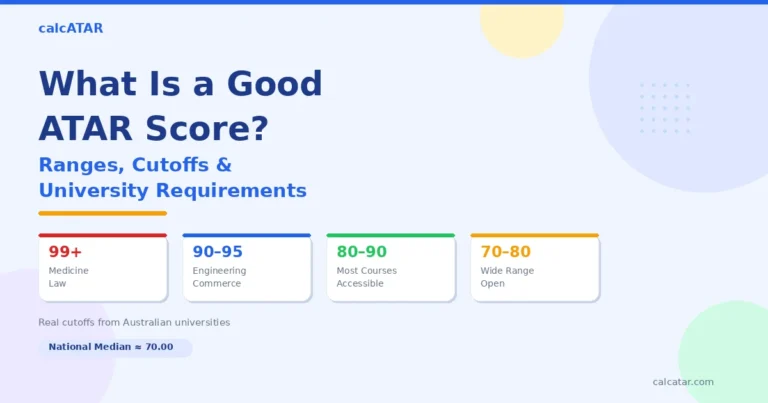
Law remains one of the highest-demand undergraduate courses in Australia. At Go8 universities, combined law degrees (e.g. Arts/Law, Commerce/Law) typically require ATARs between 95 and 99.5. More accessible options exist at mid-tier and regional universities.
| University | Course | ATAR Cutoff | Notes |
|---|---|---|---|
| University of Sydney | Combined LLB (e.g. Arts/Law) | 99.50 | Highest law cutoff in Australia |
| University of Melbourne | Juris Doctor (postgrad only) | 99.00+ | No undergraduate law — JD after bachelor’s degree |
| University of Queensland | LLB (Honours) | 98.00 | Standalone or combined |
| UNSW Sydney | Combined LLB (e.g. Commerce/Law) | 97.70 | Combined programs only |
| Monash University | LLB (Honours) | 97.10 | Standalone or combined |
| ANU | LLB (Honours) | 97.00 | Single or combined |
| UWA | Juris Doctor (direct entry) | 95.00 | Undergraduate JD pathway |
| Macquarie University | Combined LLB | 92.00 | Good mid-tier option |
| UTS | Combined LLB | 91.50 | Strong practical focus |
| Curtin University | LLB | 80.00–85.00 | Most accessible Go8-adjacent option |
| Charles Sturt University | LLB (online available) | ~75.00 | Regional / distance option |
| University of Southern Queensland | LLB | ~68.00 | Lowest Go8-accredited law option |
Engineering ATAR Requirements
Engineering cutoffs vary significantly by discipline. Software and biomedical engineering sit at the top (90–96), while civil, mechanical, and electrical engineering are more accessible (75–92). Most programs require completion of HSC Mathematics Advanced or equivalent.
| University | Discipline | ATAR Cutoff | Prerequisites |
|---|---|---|---|
| UNSW Sydney | Software Engineering | 96.00 | Maths Adv + Physics recommended |
| University of Sydney | Biomedical Engineering | 95.00 | Maths Adv + Physics or Chemistry |
| UNSW Sydney | Mechanical / Civil / Electrical | 92.00 | Maths Adv + Physics recommended |
| University of Sydney | Civil / Electrical | 92.00 | Maths Adv |
| UQ | Biomedical / Software | 92.00 | Maths B + senior science |
| Monash University | Software / Computer Systems | 92.00 | Maths Methods + one of Physics/Chem |
| University of Melbourne | Via B.Science → Masters | 88.00 | Maths Methods (Melb model) |
| Monash University | Civil / Mechanical / Electrical | 85.00 | Maths Methods |
| University of Adelaide | All disciplines | 80.00 | Maths Methods or Specialist |
| Curtin University | Mechanical Engineering | 78.00 | Maths Methods + Physics |
| RMIT | Chemical / Electrical | 75.00 | Maths Methods |
| UTS | All engineering disciplines | 69.00 | Maths Adv (lowest Go8-tier eng) |
| Western Sydney | Engineering (portfolio entry) | 70.00 | Portfolio considered |
Nursing ATAR Requirements
Nursing is one of the most accessible health degrees in Australia, with cutoffs ranging from 60 to 85 depending on the university. Combined Nursing/Midwifery programs sit higher. All nursing graduates must register with AHPRA to practise.
| University | Course | ATAR Cutoff | Notes |
|---|---|---|---|
| University of Sydney | Bachelor of Nursing | 82.00 | Competitive metro campus |
| UTS | Bachelor of Nursing | 80.00 | Strong clinical placements |
| University of the Sunshine Coast | Bachelor of Nursing | 80.00–83.00 | Selection rank incl. adjustments |
| La Trobe University (Melbourne) | Bachelor of Nursing | 70.00 | Multiple campuses |
| La Trobe University (Melbourne) | Bachelor of Nursing / Midwifery | 81.00 | Combined program — higher cutoff |
| Deakin University | Bachelor of Nursing | 70.00 | Access scheme: as low as 51.35 |
| Australian Catholic University | Bachelor of Nursing | 62.00–70.00 | Varies by campus |
| Griffith University | Bachelor of Nursing | 68.00 | Gold Coast and Logan campuses |
| Western Sydney University | Bachelor of Nursing | 65.00 | Largest nursing cohort in Australia |
| La Trobe University (Mildura) | Bachelor of Nursing | 63.00 | Regional campus — lower cutoff |
| Charles Sturt University | Bachelor of Nursing | 60.00 | Regional / online options |
Business & Commerce ATAR Requirements
Business and commerce degrees have a wide spread — from 65 at regional universities to 95+ at Go8 institutions. These are among the most popular degrees in Australia, which keeps cutoffs competitive at top universities.
| University | Course | ATAR Cutoff | Notes |
|---|---|---|---|
| University of Sydney | Bachelor of Commerce | 95.00 | Specialisations incl. Finance, Accounting |
| University of Melbourne | Bachelor of Commerce | 93.00 | Melbourne Model — broad first year |
| UNSW Sydney | Bachelor of Commerce | 93.00 | Strong finance and accounting reputation |
| UQ | Bachelor of Commerce | 87.00 | Competitive for a Go8 |
| ANU | Bachelor of Commerce | 85.00 | Small cohort, personalised |
| UTS | Bachelor of Business | 85.00 | Industry internship focus |
| Monash University | Bachelor of Commerce | 75.00 | Most accessible Go8 commerce |
| Macquarie University | Bachelor of Commerce | 75.00 | Strong accounting program |
| QUT | Bachelor of Business | 79.00 | Real-world business focus |
| RMIT | Bachelor of Business | 70.00 | Practical, industry-linked |
| Western Sydney University | Bachelor of Business | 65.00 | Accessible metro option |
Arts & Humanities ATAR Requirements
Arts degrees consistently have the widest ATAR range of any course category — from 60 at regional universities to 88 at the University of Melbourne. If you have a strong ATAR, arts at a Go8 gives you access to elite research opportunities and exchange programs. If your ATAR is modest, you can still study the same disciplines at a mid-tier or regional university.
| University | Course | ATAR Cutoff | Notes |
|---|---|---|---|
| University of Melbourne | Bachelor of Arts | 88.00 | Highest arts cutoff in Australia |
| University of Sydney | Bachelor of Arts | 80.00 | Wide major selection |
| UNSW Sydney | Bachelor of Arts | 80.00 | Includes social sciences |
| ANU | Bachelor of Arts | 80.00 | Strong international relations, politics |
| UWA | Bachelor of Arts | 80.00 | Broad first-year structure |
| UQ | Bachelor of Arts | 75.00 | Strong humanities research |
| Macquarie University | Bachelor of Arts | 75.00 | Linguistics and media strength |
| RMIT | Bachelor of Arts | 75.00 | Creative industries focus |
| Monash University | Bachelor of Arts | 70.00 | Most accessible Go8 arts |
| Griffith University | Bachelor of Arts | 65.00 | Flexible program |
| Charles Sturt University | Bachelor of Arts | 60.00 | Regional / online |
Teaching & Education ATAR Requirements
Teaching degrees typically require ATARs between 60 and 80. Several state governments have set policy minimums (around 70 in Victoria and WA), though actual offers can dip below those thresholds through access schemes. Early childhood education programs generally have the lowest cutoffs, while secondary education and combined programs sit higher.
| University | Course | ATAR Cutoff | Notes |
|---|---|---|---|
| University of Queensland | Bachelor of Education (Primary) | 75.00 | Competitive for education |
| University of Newcastle | Bachelor of Education (Secondary) | 72.00 | Strong practical placement |
| Australian Catholic University | Bachelor of Education | 70.00 | Multiple campuses nationwide |
| Deakin University | Bachelor of Education (Primary) | 67.00–70.00 | Access scheme available |
| University of Southern Queensland | Bachelor of Education (Secondary) | 66.00 | Regional / online delivery |
| La Trobe University | Bachelor of Education | 65.00 | Multiple campuses |
| Charles Sturt University | Bachelor of Education | 60.00 | Online + regional campuses |
| Victoria University | Bachelor of Education (P-12) | 59.00–72.00 | Range depends on access schemes |
| Federation University | Bachelor of Education (Early Childhood) | 50.00–70.00 | Lowest threshold nationally |
IT & Computer Science ATAR Requirements
Computer science and IT cutoffs range from 60 at regional universities to 95 at the University of Sydney. Demand for IT graduates has kept cutoffs stable, and many universities offer generous bonus points for students with strong maths backgrounds.
| University | Course | ATAR Cutoff | Prerequisites |
|---|---|---|---|
| University of Sydney | B Advanced Computing (Honours) | 95.00 | Maths Adv |
| UNSW Sydney | B Science (Computer Science) | 93.00 | Maths Adv |
| Monash University | B Computer Science (Advanced) | 88.00 | Maths Methods |
| University of Melbourne | B Science (Computing & Software) | 85.00 | Maths Methods |
| UQ | B Computer Science | 85.00 | Maths B |
| ANU | B IT / B Software Engineering | 85.00 | Maths Methods |
| UTS | B Science in IT | 82.00 | None specified |
| University of Adelaide | B Computer Science | 80.00 | Maths Methods |
| QUT | B Computer Science | 78.00 | Maths B |
| RMIT | B Computer Science | 75.00 | None specified |
| Griffith University | B Computer Science | 75.00 | None specified |
| Macquarie University | B IT | 75.00 | None specified |
| Western Sydney | B Computer Science | 72.00 | None specified |
| La Trobe University | B Information Technology | 65.00 | None specified |
| Deakin University | B Information Technology | 62.00 | None specified |
| Swinburne | B Information Technology | 60.00 | None specified |
| Charles Sturt University | B Information Technology | 60.00 | None specified |
Lowest ATAR to Get Into University
You do not need an ATAR of 90 to go to university. Many legitimate, accredited universities accept students with ATARs in the 50s and 60s — particularly for arts, education, IT, and general science programs at regional campuses.
| ATAR Range | Typical Courses Available | Example Universities |
|---|---|---|
| 50–60 | Arts, Education (Early Childhood), IT, Social Work | Federation, CSU, Victoria University, CQUniversity |
| 60–70 | Nursing, Business, Science, Teaching, Criminal Justice | ACU, WSU, Griffith, UniSQ, SCU |
| 70–80 | Commerce, Engineering (mid-tier), Physiotherapy, Psychology | RMIT, QUT, Deakin, UTS, Macquarie |
| 80–90 | Engineering (Go8), Science (Go8), Architecture, Pharmacy | Monash, Adelaide, UQ, ANU, Melbourne |
| 90+ | Medicine, Law, Dentistry, Veterinary, Combined degrees | Sydney, UNSW, Melbourne, Monash, UQ |
Courses With No ATAR Requirement
Some courses do not use the ATAR at all for selection. Instead, they assess you on talent, experience, or aptitude:
| Course Type | Selection Method | Example Universities |
|---|---|---|
| Fine Arts / Visual Arts | Portfolio review | VCA (Melbourne), UNSW Art & Design, ANU School of Art |
| Music / Performing Arts | Audition + interview | Sydney Conservatorium, Melbourne Conservatorium, WAAPA |
| Film & Screen Production | Portfolio + interview | AFTRS, VCA, Griffith Film School |
| Design (Fashion, Industrial) | Portfolio review | RMIT, UTS, QUT |
| Elite Athlete Pathways | Sporting achievement + interview | AIS-linked programs at multiple universities |
| Foundation / Pathway Programs | Academic record or mature age | Most universities offer these |
Bonus Points & Adjustment Factors
Bonus points (also called “adjustment factors” or “equity access schemes”) can add between 1 and 10 points to your selection rank. Most students qualify for at least one scheme. These points do not change your ATAR — they increase your selection rank, which is what universities compare.
Types of Adjustment Factors
| Type | Points Available | Who Qualifies | How It Works |
|---|---|---|---|
| Subject Adjustments | 1–5 points | Students who studied specific subjects relevant to the course | E.g., doing HSC Chemistry adds points for a Pharmacy degree at some universities |
| Equity / Access Schemes | 1–10 points | First-in-family, low SES, Indigenous, disability, financial hardship | Apply through your state admissions centre — often requires a supporting statement |
| Regional / Rural Bonus | 2–5 points | Students from regional, rural, or remote areas | Based on your home postcode — applied automatically in most states |
| School Performance | 1–3 points | High-performing students relative to their school context | E.g., VTAC’s SEAS “schools context” considers the socio-educational profile of your school |
| University-Specific Programs | Varies | Students who attend open days, complete bridging modules, or have specific achievements | E.g., Monash Guarantee, UNSW Gateway, UQ Headstart |
Alternative Pathways If Your ATAR Falls Short
If your ATAR does not meet the cutoff for your dream course, you are not locked out. More than 30% of Australian university students enter through alternative pathways. Here are the most common options:
| Pathway | How It Works | Time to University Entry | Best For |
|---|---|---|---|
| TAFE Diploma → University | Complete a Diploma at TAFE, then transfer with credit into 2nd year of a bachelor’s | 1 year (Diploma) + 2 years (degree) | Students who want practical learning first |
| University Foundation Program | A 6–12 month preparatory program run by the university itself | 6–12 months + 3 years (degree) | Students just below the cutoff |
| Diploma-to-Degree Pathway | Complete a university-run diploma (not TAFE), then enter 2nd year | 1 year + 2 years | Students who want to stay at the target university |
| STAT Test | Sit the Special Tertiary Admissions Test — your score replaces or supplements your ATAR | Immediate (if accepted) | Mature-age students or those with no ATAR |
| Internal Transfer | Enrol in a lower-cutoff course at the same university, then transfer after strong 1st-year results | 1 year + remaining degree | Students who want a specific Go8 university |
| Mature Age Entry | Apply as a mature-age student (21+) using work experience and/or STAT test | Immediate (if accepted) | Gap-year students, career changers |
| Portfolio / Interview Entry | Submit a portfolio of work or attend an interview in lieu of ATAR | Immediate (if accepted) | Creative arts, design, music students |
| Second-Round Offers | Apply for courses that still have vacancies after the first round — cutoffs often drop 2–5 points | Immediate | Students just below the cutoff |
Where to Check Cutoffs by State
Each state has its own Tertiary Admissions Centre (TAC) that publishes official ATAR cutoffs. Bookmark these — they are updated annually after each offer round:
| State / Territory | Admissions Body | Website | When Cutoffs Update |
|---|---|---|---|
| NSW & ACT | UAC (Universities Admissions Centre) | uac.edu.au | January (after Round 1 offers) |
| Victoria | VTAC (Victorian Tertiary Admissions Centre) | vtac.edu.au | January (after Round 1 offers) |
| Queensland | QTAC (Queensland Tertiary Admissions Centre) | qtac.edu.au | January–February |
| Western Australia | TISC (Tertiary Institutions Service Centre) | tisc.edu.au | January |
| South Australia & NT | SATAC (SA Tertiary Admissions Centre) | satac.edu.au | January |
| Tasmania | UTAS (direct application) | utas.edu.au | December–January |
Tips for Meeting Your Target ATAR
Frequently Asked Questions
Final Thoughts
ATAR cutoffs are a guide, not a wall. They shift every year, they vary between campuses, and they can be lowered by bonus points you might not even know you qualify for. The students who get into their target course are the ones who research early, apply for every scheme available, have a realistic backup plan, and do not assume a published cutoff is a fixed rule.
I really suggest you estimate your ATAR right now with the calculator for your state, compare it against the cutoffs in this guide, and identify the gap. If the gap is small, bonus points and second-round offers might close it. If the gap is large, alternative pathways exist — and the degree you earn at the end is the same nationally accredited qualification.
Good luck. You have more options than you think.
— Daniel Mitchell, calcATAR