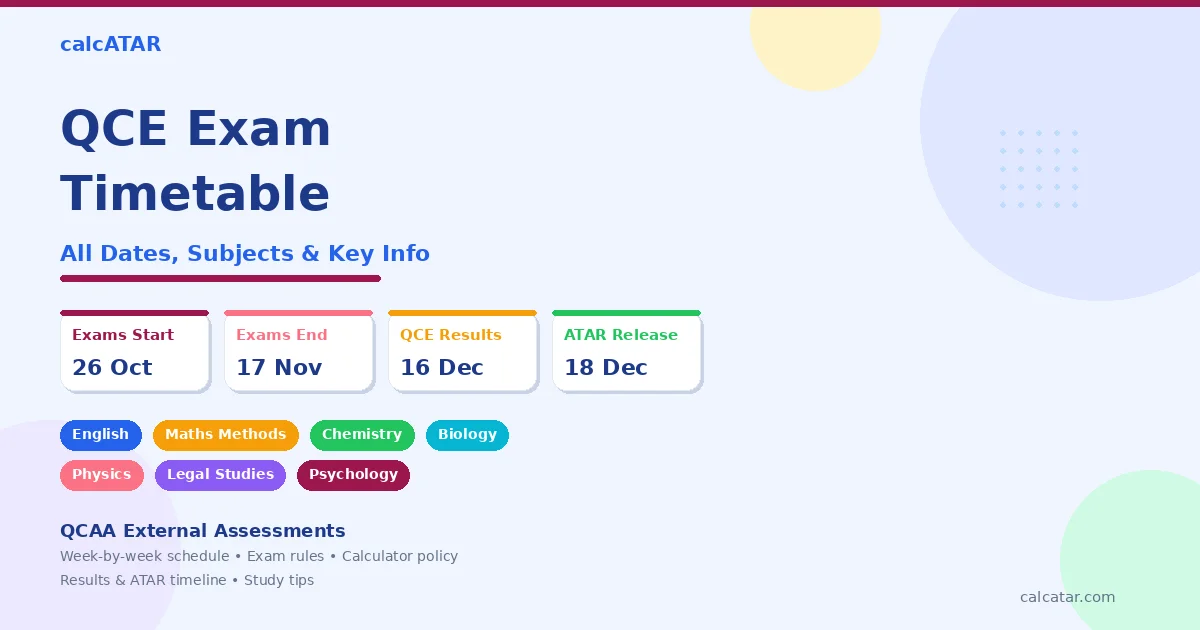
This QCE exam timetable 2026 lists every external assessment from Monday 26 October to Tuesday 17 November, with session times, paper durations and exam rules for all General subjects.
📅 QCE External Assessment Period: Monday 26 October – Tuesday 17 November 2026
📝 First Exam: Economics & Aerospace Systems — Monday 26 October (AM session)
📝 Last Exam: Agricultural Science Papers 1 & 2 — Tuesday 17 November
📊 QCE Results Released: Wednesday 16 December 2026 (via QCAA learner account)
🎓 Queensland ATAR Released: Friday 18 December 2026, 9:00 am (via QTAC)
🏫 QTAC Round 1 Offers: Mid-January 2027
The QCE external assessment timetable runs over four weeks from late October to mid-November. This guide includes the complete day-by-day schedule sourced from the official QCAA timetable, covering every General and General Extension subject. Use it alongside the QCE ATAR Calculator to estimate where your results will land.
📋 Table of Contents
How the QCE System Works
Queensland’s QCE (Queensland Certificate of Education) system works differently from VCE or HSC. Here is how your results flow from the classroom to your ATAR:
- Internal assessments (IA) — your school marks you on 3 internal assessment instruments per subject throughout Year 12. These are moderated by QCAA to ensure consistency across schools.
- External assessments (EA) — the exams in this timetable. For most General subjects, the external exam is worth 25% of your final subject result. For Maths and Sciences, it is worth 50% (split across two papers).
- QCAA confirms your subject results — combining your moderated internal assessments with your external exam performance to produce a final result from A to E.
- QTAC calculates your ATAR — using your best five General subject results (or equivalent) to produce a rank from 0.00 to 99.95.
Week 1: Monday 26 – Friday 30 October 2026
| Date | Session | Subject | Duration |
|---|---|---|---|
| Monday 26 October | |||
| 26 Oct | AM | Economics | 2h 15min |
| 26 Oct | AM | Aerospace Systems | 2h 5min |
| 26 Oct | PM | Music | 2h 20min |
| Tuesday 27 October | |||
| 27 Oct | AM | English | 2h 15min |
| 27 Oct | AM | English as an Additional Language (EAL) | 2h 15min |
| 27 Oct | AM | Ancient History | 2h 15min |
| 27 Oct | PM | Spanish | 2h 5min |
| 27 Oct | PM | Visual Art | 2h 20min |
| Wednesday 28 October | |||
| 28 Oct | AM | Chinese | 2h 5min |
| 28 Oct | AM | Philosophy & Reason | 2h 15min |
| 28 Oct | AM | Chemistry — Paper 1 | 90min + 5min reading |
| 28 Oct | PM | Legal Studies | 2h 15min |
| 28 Oct | PM | Chemistry — Paper 2 | 90min + 5min reading |
| Thursday 29 October | |||
| 29 Oct | AM | Physical Education | 2h 5min |
| Friday 30 October | |||
| 30 Oct | AM | Literature | 2h 15min |
| 30 Oct | PM | Health | 2h 15min |
Week 2: Monday 2 – Friday 6 November 2026
| Date | Session | Subject | Duration |
|---|---|---|---|
| Monday 2 November | |||
| 2 Nov | AM | Biology — Paper 1 | 90min + 5min reading |
| 2 Nov | PM | Biology — Paper 2 | 90min + 5min reading |
| 2 Nov | PM | Business | 2h 15min |
| Tuesday 3 November | |||
| 3 Nov | AM | Aboriginal & Torres Strait Islander Studies | 2h 15min |
| 3 Nov | AM | German | 2h 5min |
| 3 Nov | AM | Study of Religion | 2h 15min |
| 3 Nov | PM | Music Extension | 2h 20min |
| 3 Nov | PM | Accounting | 2h 15min |
| 3 Nov | PM | Drama | 2h 20min |
| Wednesday 4 November | |||
| 4 Nov | AM | Film, Television & New Media | 2h 20min |
| 4 Nov | AM | Chinese Extension | 2h 20min |
| 4 Nov | AM | French Extension | 2h 20min |
| 4 Nov | AM | German Extension | 2h 20min |
| 4 Nov | PM | Italian | 2h 5min |
| 4 Nov | PM | General Mathematics — Paper 1 | 90min + 5min reading |
| 4 Nov | PM | Specialist Mathematics — Paper 1 | 90min + 5min reading |
| Thursday 5 November | |||
| 5 Nov | AM | Modern History | 2h 15min |
| 5 Nov | AM | General Mathematics — Paper 2 | 90min + 5min reading |
| 5 Nov | AM | Specialist Mathematics — Paper 2 | 90min + 5min reading |
| 5 Nov | PM | Design | 2h 15min |
Week 3: Monday 9 – Friday 13 November 2026
| Date | Session | Subject | Duration |
|---|---|---|---|
| Monday 9 November | |||
| 9 Nov | AM | Physics — Paper 1 | 90min + 5min reading |
| 9 Nov | PM | Physics — Paper 2 | 90min + 5min reading |
| 9 Nov | PM | Psychology — Paper 1 | 90min + 5min reading |
| 9 Nov | PM | Earth & Environmental Science — Paper 1 | 90min + 5min reading |
| 9 Nov | PM | Engineering | 2h 5min |
| 9 Nov | PM | Food & Nutrition | 2h 5min |
| Tuesday 10 November | |||
| 10 Nov | AM | Dance | 2h 20min |
| 10 Nov | AM | Digital Solutions | 2h 5min |
| 10 Nov | AM | English & Literature Extension | 2h 30min |
| Wednesday 11 November | |||
| 11 Nov | AM | Psychology — Paper 2 | 90min + 5min reading |
| 11 Nov | AM | Earth & Environmental Science — Paper 2 | 90min + 5min reading |
| 11 Nov | AM | Geography | 2h 15min |
| 11 Nov | AM | Mathematical Methods — Paper 1 | 90min + 5min reading |
| 11 Nov | PM | French | 2h 5min |
| 11 Nov | PM | Japanese | 2h 5min |
| 11 Nov | PM | Mathematical Methods — Paper 2 | 90min + 5min reading |
| Thursday 12 – Friday 13 November | |||
| No General subject external assessments scheduled | |||
Week 4: Monday 16 – Tuesday 17 November 2026
| Date | Session | Subject | Duration |
|---|---|---|---|
| Monday 16 November | |||
| 16 Nov | AM | Marine Science — Paper 1 | 90min + 5min reading |
| 16 Nov | PM | Marine Science — Paper 2 | 90min + 5min reading |
| Tuesday 17 November | |||
| 17 Nov | AM | Agricultural Science — Paper 1 | 90min + 5min reading |
| 17 Nov | PM | Agricultural Science — Paper 2 | 90min + 5min reading |
Popular Subjects: Quick Reference
Here are the 15 most popular QCE subjects sorted by exam date — the ones most Year 12 students need:
| Subject | Date | Session | Format | Duration |
|---|---|---|---|---|
| Economics | Mon 26 Oct | AM | Single paper | 2h 15min |
| English / EAL | Tue 27 Oct | AM | Single paper | 2h 15min |
| Ancient History | Tue 27 Oct | AM | Single paper | 2h 15min |
| Chemistry | Wed 28 Oct | AM + PM | 2 papers | 90min each |
| Legal Studies | Wed 28 Oct | PM | Single paper | 2h 15min |
| Physical Education | Thu 29 Oct | AM | Single paper | 2h 5min |
| Literature | Fri 30 Oct | AM | Single paper | 2h 15min |
| Biology | Mon 2 Nov | AM + PM | 2 papers | 90min each |
| General Mathematics | Wed 4 – Thu 5 Nov | PM + AM | 2 papers | 90min each |
| Specialist Mathematics | Wed 4 – Thu 5 Nov | PM + AM | 2 papers | 90min each |
| Modern History | Thu 5 Nov | AM | Single paper | 2h 15min |
| Physics | Mon 9 Nov | AM + PM | 2 papers | 90min each |
| Psychology | Mon 9 + Wed 11 Nov | PM + AM | 2 papers | 90min each |
| Mathematical Methods | Wed 11 Nov | AM + PM | 2 papers | 90min each |
| Geography | Wed 11 Nov | AM | Single paper | 2h 15min |
Internal vs External Assessments: How They Work Together
Queensland’s QCE system combines internal and external assessments — but the weighting depends on the subject type. Here is the breakdown:
| Subject Category | Internal Assessment (IA) | External Assessment (EA) | Exam Format |
|---|---|---|---|
| Humanities & Social Sciences (English, History, Legal Studies, Economics, etc.) | 75% | 25% | Single paper (2h 15min) |
| Sciences (Chemistry, Biology, Physics, Earth & Env Sci, Marine Sci, Ag Sci) | 50% | 50% | Two papers (90min each) |
| Mathematics (General Maths, Maths Methods, Specialist Maths) | 50% | 50% | Two papers (90min each) |
| Arts (Music, Drama, Dance, Visual Art, Film/TV) | 75% | 25% | Single paper (2h 20min) |
| Technologies (Digital Solutions, Engineering, Food & Nutrition, Aerospace) | 75% | 25% | Single paper (2h 5min) |
| Health & PE (Health, Physical Education) | 75% | 25% | Single paper (2h 5–15min) |
QCE Exam Rules & What to Bring
What to Bring
- Student ID or photo identification — your school will confirm what form of ID is required
- Black or dark blue pens (at least two — bring spares)
- Pencils and eraser (for diagrams and multiple-choice)
- Ruler and clear pencil case (no opaque cases)
- QCAA-approved calculator — for Maths and Science papers only (see below)
- Water bottle (clear, no labels)
- Subject-specific permitted materials — check the QCAA examination specifications for your subject (some subjects allow formula sheets provided by QCAA)
What NOT to Bring
- ❌ Mobile phones or smartwatches (leave in your bag outside the exam room)
- ❌ Notes, textbooks, or reference sheets (unless specified as permitted)
- ❌ Correction fluid (liquid paper / whiteout)
- ❌ Programmable or graphing calculators (unless your subject permits them)
- ❌ Electronic dictionaries
Tips for QCE Exam Preparation
What Happens After QCE Exams
Once your last external assessment is done on 17 November, here is the timeline:
| Date | Event | What You Need to Do |
|---|---|---|
| 17 November 2026 | Last QCE external assessment | Relax — you have earned it |
| Late November | QTAC preferences close for Round 1 | Finalise your QTAC course preferences (you can still change until the deadline) |
| 16 December 2026 | QCE results released by QCAA | Log into your QCAA learner account to see your subject results (A–E) |
| 18 December 2026 | Queensland ATAR released by QTAC (9:00 am) | Log into your QTAC account to see your ATAR |
| 18 Dec – 31 Jan | Change of preference window | Update your QTAC preferences based on your actual ATAR — this is your most strategic move |
| Mid-January 2027 | QTAC Round 1 offers | Accept, defer, or wait for subsequent rounds |
| Late January – February | QTAC Rounds 2 & 3 | Additional offers — cutoffs often drop by 2–5 points in later rounds |
Bookmark this QCE exam timetable 2026 for quick reference during the study period. If QCAA amends the official QCE exam timetable 2026, the dates above will be updated.
Frequently Asked Questions
Final Thoughts
The QCE external assessment period is intense but short — four weeks and it is done. The students who perform best are the ones who know their timetable inside out, plan their study blocks around the gaps between exams, and walk into each session with no surprises about format, timing, or what they can bring.
I really suggest you bookmark this timetable, mark your personal exam dates in a calendar or planner, and start working backwards from 26 October right now. Estimate your ATAR with the QCE ATAR Calculator to see where you stand, and use that number to set your QTAC preferences strategically. After results drop on 18 December, the change of preference window is your most powerful tool — have your backup courses researched and ready.
Good luck, Queensland. You have got this.
— Daniel Mitchell, calcATAR