📋 Table of Contents
- What Does ATAR Stand For?
- ATAR Is a Rank, Not a Score
- Brief History of the ATAR
- Who Receives an ATAR?
- Who Does NOT Receive an ATAR?
- How Universities Use Your ATAR
- ATAR Range Breakdown
- State-by-State ATAR Systems
- How Is ATAR Calculated?
- ATAR vs Other Entry Pathways
- Common Misconceptions About ATAR
- How to Check Your ATAR
- How to Estimate Your ATAR Before Results
- Tips for Year 12 Students
- Frequently Asked Questions
ATAR stands for Australian Tertiary Admission Rank. It is the primary number used by Australian universities to rank and compare Year 12 applicants for undergraduate admission. If you are in Year 12 right now (or a parent, teacher, or career counsellor helping someone who is), this guide covers everything you need to know about what ATAR is, how it works, and what it means for university entry.
What Does ATAR Stand For?
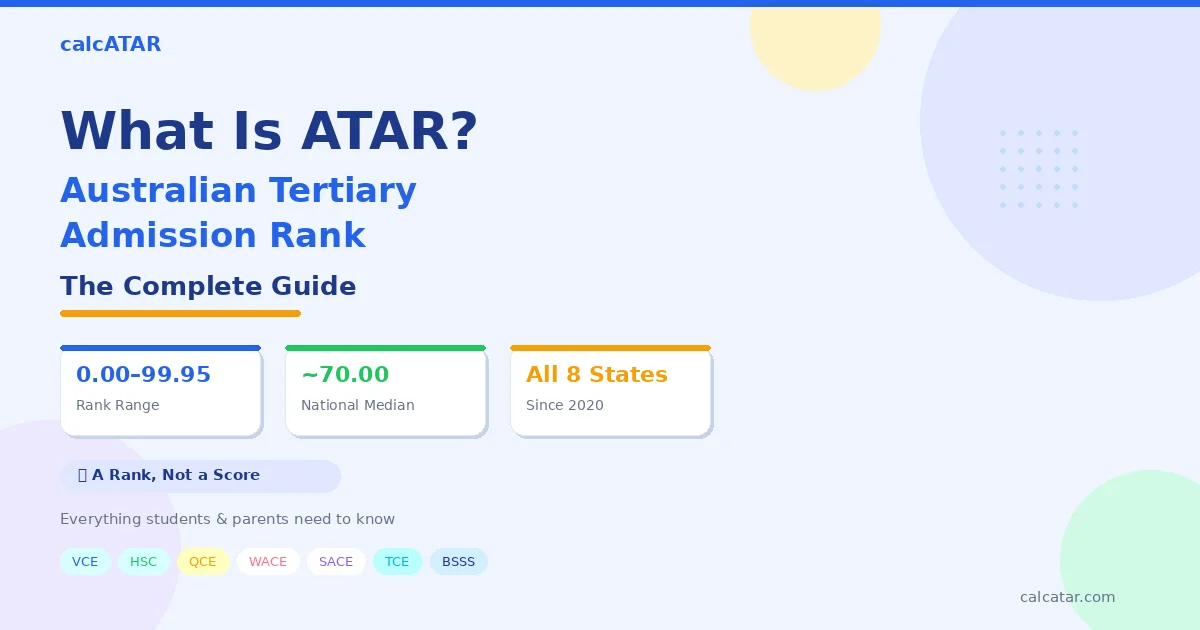
ATAR stands for Australian Tertiary Admission Rank. The key word is rank. Your ATAR is not a mark, not a grade, and not a percentage score on your exams. It is a percentile ranking that tells you where you sit relative to all other students in your Year 12 age cohort — including those who did not complete Year 12 or did not take an ATAR-eligible pathway.
The ATAR is expressed as a number between 0.00 and 99.95, in increments of 0.05. An ATAR of 85.00 means you performed better than 85% of all people in your age group across the entire state, not just those who sat exams.
ATAR Is a Rank, Not a Score — Here’s the Difference
This is the single most misunderstood fact about the ATAR. Most people hear “I got an 80” and assume it means 80% on their exams. It does not.
| What People Think | What ATAR Actually Means |
|---|---|
| “I scored 90 out of 100” | You performed better than 90% of the Year 12 age cohort |
| “I got 70%, that’s average” | An ATAR of 70 is above the median — top 30% of the cohort |
| “99.95 is a perfect score” | 99.95 means you are in the top 0.05% — it is not 100/100 |
| “I failed — I got 55” | An ATAR of 55 still places you ahead of 55% of the age group |
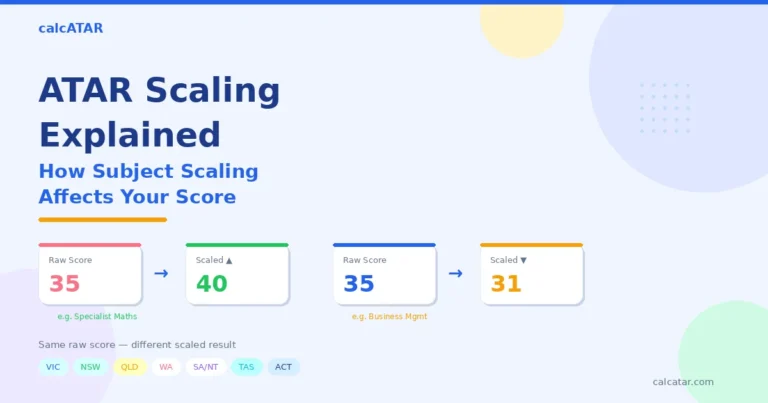
Your ATAR is calculated from your scaled subject scores (not raw exam marks), which are then converted into a percentile rank against the entire age population of your state. The scaling process is explained in detail in our ATAR Scaling Explained guide.
Brief History of the ATAR
Before 2010, every Australian state had its own university entrance ranking system with its own name. This made interstate comparisons confusing for students, universities, and employers. In June 2009, then-Education Minister Julia Gillard announced a national system: the ATAR.
| State | Old System | Year ATAR Adopted |
|---|---|---|
| NSW & ACT | UAI (University Admission Index) | 2009 |
| Victoria | ENTER (Equivalent National Tertiary Entrance Rank) | 2010 |
| South Australia & NT | TER (Tertiary Entrance Rank) | 2010 |
| Western Australia | TER (Tertiary Entrance Rank) | 2010 |
| Tasmania | TER (Tertiary Entrance Rank) | 2010 |
| Queensland | OP (Overall Position, 1–25 scale) | 2020 |
Queensland was the last state to adopt the ATAR, transitioning from the OP system in 2020. The 2020 QCE cohort were the first Queensland students to receive an ATAR instead of an OP. Since 2020, all eight states and territories use the same ATAR ranking system, though each calculates it through its own scaling body.
Who Receives an ATAR?
To receive an ATAR, you generally must meet all of the following:
- Be an Australian or New Zealand citizen, permanent resident, or holder of a qualifying visa (including humanitarian and refugee visa holders)
- Complete Year 12 through an ATAR-eligible pathway in an Australian state or territory
- Study the required number of ATAR-eligible subjects — typically 4–6 subjects at the highest level (Units 3 & 4 in Victoria, Band 6 subjects in NSW, etc.)
- Include at least one English subject in your study program (this is mandatory in every state except Tasmania, which allows alternatives demonstrating communication competency)
- Complete all required assessment components — internal assessments and external exams
Who Does NOT Receive an ATAR?
Not every Year 12 student receives an ATAR. You will not receive one if you:
- Are an international student on a student visa — you apply to universities directly, not through the ATAR system
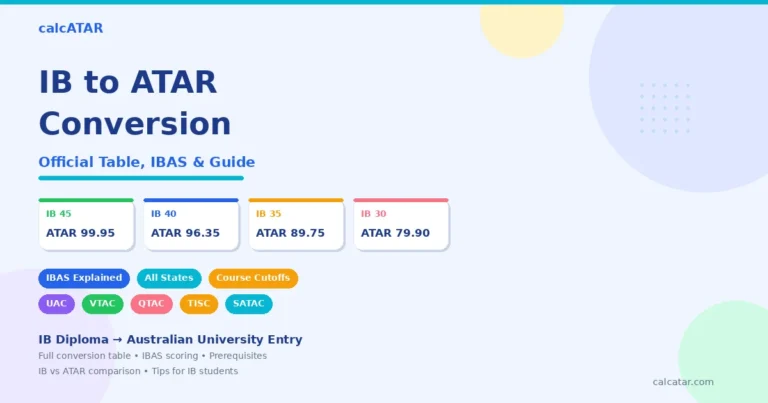
- Complete an International Baccalaureate (IB) Diploma — IB students receive a separate score out of 45, which is then converted to an ATAR-equivalent by the relevant admission centre (e.g., SATAC publishes an IB-to-ATAR conversion table each year)
- Take only VET (Vocational Education and Training) subjects without enough ATAR-eligible academic subjects
- Do not complete enough qualifying subjects — for example, if you drop below the minimum subject count before the end of Year 12
- Leave school before completing Year 12
- Study through a non-ATAR pathway — such as VCAL (now VPC) in Victoria, or certain alternative completion certificates
If you do not receive an ATAR, you are not locked out of university. There are alternative entry pathways that thousands of students use every year.
How Universities Use Your ATAR for Admissions
Universities publish a lowest selection rank (sometimes called a “cutoff”) for each course. Your ATAR is one component of your selection rank, which may also include:
- Subject adjustments — bonus points for completing relevant prerequisite subjects
- Equity adjustments (SEAS) — points for financial hardship, disability, rural/remote location, or other disadvantage
- Regional preferences — some universities give bonus points for applicants from their local area
Your selection rank = ATAR + any applicable bonus points. Universities rank all applicants by selection rank and offer places from the top down until the course is full. The lowest selection rank that received an offer becomes the published “cutoff” for that intake year.
ATAR Range Breakdown: What Each Score Range Means
| ATAR Range | Percentile | What It Means | Typical Course Access |
|---|---|---|---|
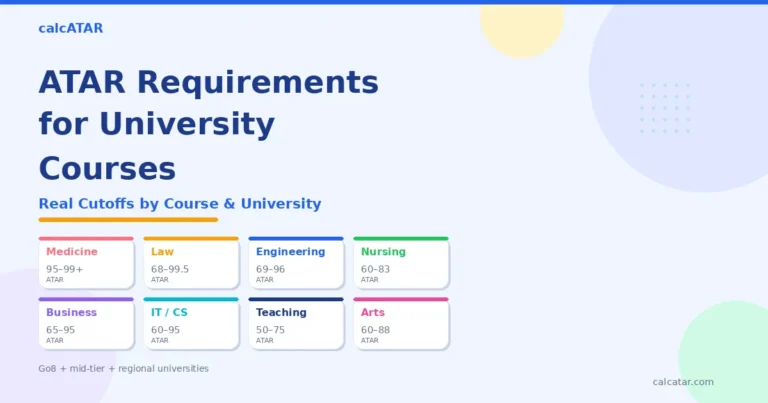
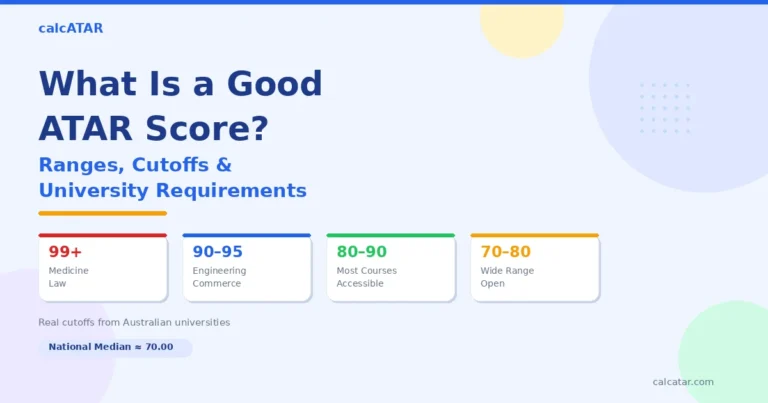
| 99.00–99.95 | Top 1% | Exceptional performance across all subjects | Medicine, Law at Go8 universities, Dentistry |
| 95.00–98.95 | Top 5% | Outstanding — opens almost every course | Law, Physiotherapy, Veterinary Science, combined degrees at top universities |
| 90.00–94.95 | Top 10% | Well above average — highly competitive | Engineering at Go8, Commerce at UNSW/Melbourne, Architecture |
| 80.00–89.95 | Top 20% | Strong — competitive for most courses | Science at Go8, IT, Nursing at major metros, most Business degrees |
| 70.00–79.95 | Top 30% | Above median — wide range of options | Arts, Education, Social Work, Health Sciences, most regional uni courses |
| 60.00–69.95 | Top 40% | Solid — opens many courses | Many Education degrees, some Nursing, Creative Arts, regional uni programs |
| Below 60 | Below top 40% | Limited direct entry — alternative pathways available | Diploma programs, TAFE pathways, foundation courses, some regional courses |
For a detailed breakdown with real university cutoffs by course, see our What Is a Good ATAR Score? guide.
State-by-State ATAR Systems
All eight Australian states and territories use the ATAR, but each has its own Year 12 qualification system, scaling method, and tertiary admissions centre. Here is how they map:
| State/Territory | Year 12 System | Admissions Body | How It Feeds Into ATAR |
|---|---|---|---|
| Victoria | VCE | VTAC | GAT-based statistical moderation → scaled study scores → aggregate of best 3 + 10% of next best 7 → ATAR |
| New South Wales | HSC | UAC | Moderated assessment marks → scaled marks → best 10 units (incl. 2 English units) → ATAR |
| Queensland | QCE | QTAC | Internal + external assessment → inter-subject scaling → best 5 subjects → ATAR |
| Western Australia | WACE | TISC | School + exam marks → standardised scores → best 4 subjects (with TEA) → ATAR |
| South Australia & NT | SACE / NTCET | SATAC | Scaled scores → best 90 credits from 20-credit subjects → university aggregate → ATAR |
| Tasmania | TCE | TASC | Standardised scores → best 5 subjects → ATAR (calculated by TASC) |
| ACT | BSSS (AST) | UAC | AST (ACT Scaling Test) + course scores → scaled aggregate → ATAR |
For the full calculation methodology in each state, see How Is ATAR Calculated?
Use the calculator for your state to estimate your ATAR: VCE · HSC · QCE · WACE · SACE · TCE · BSSS
How Is ATAR Calculated?
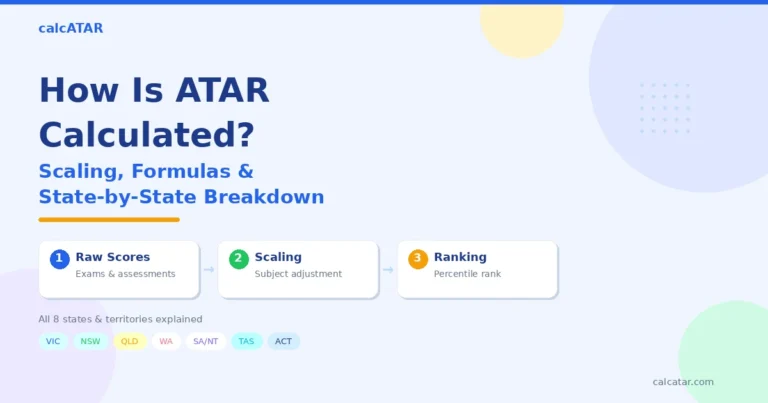
The ATAR calculation follows a three-stage process in every state (though the specifics vary):
- Raw scores are produced — from your internal assessments and external exams
- Scores are scaled — adjusted to account for different subject difficulties and cohort strengths (see ATAR Scaling Explained)
- Scaled scores are aggregated — your best results are combined into an aggregate, which is then converted into a percentile rank against the full Year 12 age population
Since 2020, all states use a one-parameter cubic spline model to convert aggregate scores into ATAR percentiles. This ensures the ranking methodology is statistically consistent nationwide, even though each state calculates aggregates differently.
For the full state-by-state breakdown with worked examples, read our How Is ATAR Calculated? guide.
ATAR vs Other Entry Pathways
The ATAR is the most common way into university, but it is far from the only way. More than 30% of Australian university students enter through pathways that do not depend primarily on their ATAR. Here are the main alternatives:
| Pathway | What It Is | Who It Suits |
|---|---|---|
| Bonus Points | Universities add points to your selection rank for subject choices, equity, or location | Students just below a cutoff — a few bonus points can bridge the gap |
| Portfolio Entry | Submit a portfolio of creative work for assessment | Art, Design, Architecture, Music applicants with strong practical skills |
| STAT Test | A standardised aptitude test (Special Tertiary Admissions Test) | Mature-age students, non-Year 12 applicants, those without a recent ATAR |
| Diploma-to-Degree | Complete a 1-year diploma, then enter Year 2 of a degree with credit | Students with lower ATARs who want a Go8 pathway — many have no ATAR requirement |
| TAFE Pathway | Complete a Certificate IV or Diploma at TAFE, then transfer to university | Students who prefer practical learning first, or need a stepping stone |
| Bridging Courses | Short courses (often 3–6 months) that qualify you for specific uni programs | Students who missed prerequisites or need a targeted qualification |
| Mature-Age Entry | Apply based on work experience, life experience, or prior study (usually age 21+) | Adults returning to study without a recent ATAR |
| Schools Recommendation | Some universities accept recommendations from your school principal | Regional students, students facing disadvantage, early-offer schemes |
Common Misconceptions About ATAR
Myth 1: “ATAR is a score out of 100”
No. It is a percentile rank from 0.00 to 99.95. An ATAR of 80 does not mean you scored 80% on your exams — it means you outperformed 80% of the Year 12 age cohort. The maximum is 99.95, not 100.
Myth 2: “The average ATAR is 50”
The median ATAR is approximately 70.00. This is because the denominator includes all Year 12-aged people in the population, including those who left school early or took non-ATAR pathways. Only about 50–60% of the age group actually receive an ATAR.
Myth 3: “Your ATAR only depends on your exam results”
Your ATAR depends on your scaled subject scores, which come from a combination of internal assessments and external exams. The weighting between internal and external varies by state. In Victoria, for example, exams are typically worth 50–60% of the study score, with school-assessed coursework making up the rest.
Myth 4: “Choosing easy subjects will give you a higher ATAR”
Not necessarily. Subjects with weaker cohorts tend to scale down, which means a high raw score in that subject may translate to a lower scaled score than you expect. A strong performance in a high-scaling subject will usually contribute more to your ATAR than a top mark in a low-scaling one. See ATAR Scaling Explained for the full picture.
Myth 5: “Your ATAR follows you forever”
No employer will ever ask for your ATAR. Once you have completed a university degree (or even started one), your ATAR becomes irrelevant. It is a one-time ranking used solely for undergraduate admissions. After that, qualifications, skills, and experience are what matter.
Myth 6: “You cannot get into a good university without a high ATAR”
Every Go8 university in Australia offers alternative entry pathways — diploma programs, foundation years, and equity access schemes. Thousands of students enter top universities every year without meeting the published ATAR cutoff. The cutoff is the lowest selection rank that received an offer in that intake, not an absolute requirement.
How to Check Your ATAR
ATAR results are released in mid-to-late December each year (Queensland is mid-January). You check your ATAR through your state’s portal:
| State | Portal | Typical Release |
|---|---|---|
| Victoria (VCE) | VTAC Results & ATAR | Mid-December |
| NSW (HSC) | UAC — ATAR Online | Mid-December |
| Queensland (QCE) | QTAC ATAR | Mid-January |
| WA (WACE) | TISC Statement | Late December |
| SA & NT (SACE) | SATAC | Mid-December |
| Tasmania (TCE) | TASC Results | Late December |
| ACT (BSSS) | UAC — ATAR Online | Mid-December |
For exact dates and times for this year, see ATAR Release Dates 2026.
How to Estimate Your ATAR Before Results
You do not have to wait until December. You can estimate your ATAR at any time using your expected subject scores and historical scaling data. calcATAR offers free calculators for every state:
- VCE ATAR Calculator (Victoria)
- HSC ATAR Calculator (NSW)
- QCE ATAR Calculator (Queensland)
- WACE ATAR Calculator (Western Australia)
- SACE ATAR Calculator (South Australia & NT)
- TCE ATAR Calculator (Tasmania)
- BSSS ATAR Calculator (ACT)
For a quick ballpark with minimal input, try the 30-Second ATAR Predictor.
To see how subject scaling will affect your estimate, use the Scaling Comparison Tool.
Tips for Year 12 Students About ATAR
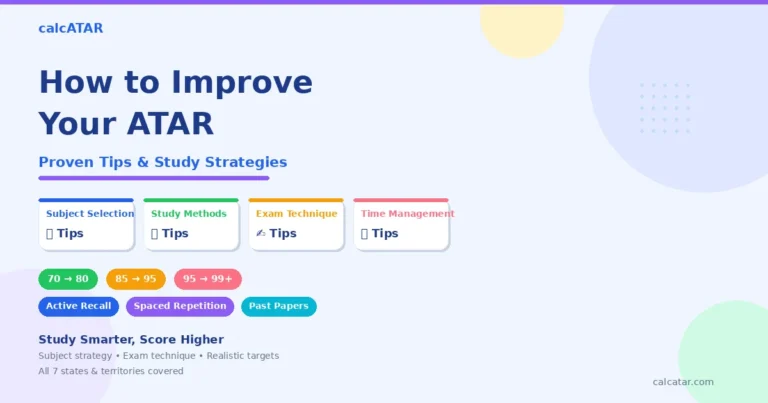
Understand what ATAR actually is. Read this guide from top to bottom. Most ATAR stress comes from misunderstanding what the number means. It is a rank, not a report card. Once you understand that, the number becomes a tool you can work with, not a judgment of your worth.
Know your target ATAR early. Look up the lowest selection rank for your preferred course at your preferred university. That is your target number. Everything you do in Year 12 should be aimed at hitting or exceeding that number — not at getting the highest ATAR possible for its own sake.
Pick subjects you will perform well in. A high raw score in any subject contributes more to your ATAR than a mediocre score in a “high-scaling” subject. Performance beats scaling every time. (But do check prerequisites first.)
Check your prerequisites before choosing subjects. Some university courses require specific subjects (e.g., Mathematical Methods or Chemistry for Medicine). If you drop a prerequisite, your ATAR does not matter — you will not be eligible regardless.
Use a calculator early and often. Enter your expected scores into a state-specific calculator at the start of Year 12, then update as your assessment results come in. This keeps your target real and visible.
Understand scaling before panicking about it. Scaling is not a punishment. It is a statistical adjustment that makes fair comparison possible. Read the ATAR Scaling Explained guide so you know exactly how it works.
Do not compare your ATAR across states. An ATAR of 80 in Victoria is the same percentile as an ATAR of 80 in NSW. The states use different calculation methods, but the final ATAR is a nationally comparable percentile. There is no “easier” state.
Know your bonus point options. Many universities offer subject adjustments (bonus points for specific subjects), equity adjustments (SEAS), and regional bonuses. These are added to your ATAR to create a selection rank. A few bonus points can push you above a cutoff.
Have a Plan B. Look into diploma-to-degree pathways, TAFE options, and bridging courses at the start of Year 12 — not after results come out. Having a backup plan reduces stress and gives you realistic options if your ATAR falls short of your target.
Remember: ATAR is a doorway, not a destination. It gets you into a course. After that, nobody cares about the number. No employer will ever ask you what ATAR you received. Focus on getting where you need to go, then leave the number behind.
Frequently Asked Questions
Final Thoughts
The ATAR is a tool. A useful one — it gives universities a fair, standardised way to compare tens of thousands of applicants across hundreds of different subject combinations. But it is just a tool. It does not define your intelligence, your potential, or your future career.
I really suggest you treat the ATAR the way you would treat any other number in your life: understand what it measures, aim for the target you need, and do not attach your self-worth to it. Whether your target is 65 or 99, the approach is the same — know where you are going, work consistently, and use every resource available to you.
Estimate where you stand right now with the calculator for your state: VCE · HSC · QCE · WACE · SACE · TCE · BSSS
— Daniel Mitchell, calcATAR