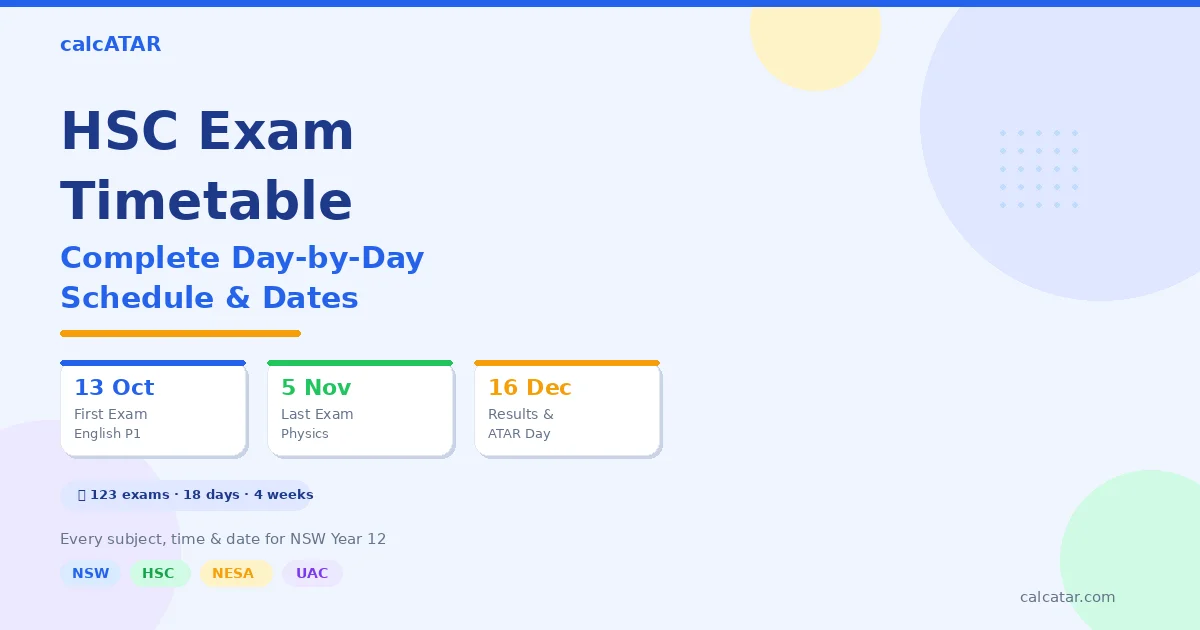
📅 HSC Exam Period: Tuesday 13 October – Thursday 5 November 2026
📝 First Exam: English Advanced/Standard/EAL-D Paper 1 — Tuesday 13 October, 9:50 am
📝 Last Exam: Physics — Thursday 5 November, 9:25 am
🔢 Total Written Exams: 123 exams across 18 exam days
📊 HSC Results Release: Wednesday 16 December 2026
📊 ATAR Release: Wednesday 16 December 2026, 9:00 am via UAC
📋 Table of Contents
The 2026 HSC written exam timetable runs from Tuesday 13 October to Thursday 5 November 2026 — 18 exam days across four weeks. NESA (NSW Education Standards Authority) released the official timetable on 1 May 2026. Below is the complete day-by-day schedule with every subject, session time, and duration.
Complete 2026 HSC Written Exam Timetable
Week 1: Tuesday 13 – Friday 16 October
| Date | Session | Subject | Time |
|---|---|---|---|
| Tuesday 13 October | |||
| 13 Oct | AM | English Advanced Paper 1 | 9:50 am – 11:30 am |
| 13 Oct | AM | English Standard Paper 1 | 9:50 am – 11:30 am |
| 13 Oct | AM | English EAL/D Paper 1 | 9:50 am – 11:30 am |
| 13 Oct | AM | English Studies | 9:50 am – 12:30 pm |
| 13 Oct | PM | Japanese Beginners | 2:00 pm – 4:00 pm |
| 13 Oct | PM | German Continuers | 2:00 pm – 5:00 pm |
| 13 Oct | PM | Japanese Continuers | 2:00 pm – 5:00 pm |
| Wednesday 14 October | |||
| 14 Oct | AM | English Advanced Paper 2 | 9:25 am – 11:30 am |
| 14 Oct | AM | English Standard Paper 2 | 9:25 am – 11:30 am |
| 14 Oct | AM | English EAL/D Paper 2 | 9:25 am – 11:30 am |
| 14 Oct | PM | Music 1 Aural Skills | 1:55 pm – 3:00 pm |
| 14 Oct | PM | Music 2 Musicology & Aural | 3:25 pm – 5:00 pm |
| Thursday 15 October | |||
| 15 Oct | AM | Earth and Environmental Science | 9:25 am – 12:30 pm |
| 15 Oct | AM | Indonesian Beginners | 9:20 am – 12:00 pm |
| 15 Oct | PM | Agriculture | 1:55 pm – 5:00 pm |
| 15 Oct | PM | Multiple language exams | 2:00 pm – 5:00 pm |
| Friday 16 October | |||
| 16 Oct | AM | Modern History | 9:25 am – 12:30 pm |
| 16 Oct | PM | Classical Greek Continuers | 1:55 pm – 5:00 pm |
Week 2: Monday 19 – Friday 23 October
| Date | Session | Subject | Time |
|---|---|---|---|
| Monday 19 October | |||
| 19 Oct | AM | Mathematics Advanced | 9:20 am – 12:30 pm |
| 19 Oct | AM | Mathematics Standard 2 | 9:20 am – 12:00 pm |
| 19 Oct | AM | Mathematics Standard 1 | 9:20 am – 11:30 am |
| 19 Oct | PM | Mathematics Extension 2 | 1:50 pm – 5:00 pm |
| Tuesday 20 October | |||
| 20 Oct | AM | Engineering Studies | 9:25 am – 12:30 pm |
| 20 Oct | AM | Latin Continuers | 9:25 am – 12:30 pm |
| 20 Oct | AM | Textiles and Design | 9:25 am – 11:00 am |
| 20 Oct | PM | Society and Culture | 1:55 pm – 4:00 pm |
| 20 Oct | PM | Chinese Continuers | 2:00 pm – 5:00 pm |
| Wednesday 21 October | |||
| 21 Oct | AM | Biology | 9:25 am – 12:30 pm |
| 21 Oct | PM | History Extension | 1:50 pm – 4:00 pm |
| Thursday 22 October | |||
| 22 Oct | AM | Studies of Religion I | 9:25 am – 11:00 am |
| 22 Oct | AM | Studies of Religion II | 9:25 am – 12:30 pm |
| 22 Oct | PM | Drama | 1:55 pm – 3:30 pm |
| 22 Oct | PM | Chinese Beginners | 2:00 pm – 4:40 pm |
| Friday 23 October | |||
| 23 Oct | AM | Ancient History | 9:25 am – 12:30 pm |
| 23 Oct | PM | Mathematics Extension 1 | 1:50 pm – 4:00 pm |
Week 3: Monday 26 – Friday 30 October
| Date | Session | Subject | Time |
|---|---|---|---|
| Monday 26 October | |||
| 26 Oct | AM | Business Studies | 9:25 am – 12:30 pm |
| 26 Oct | PM | Science Extension | 1:50 pm – 4:00 pm |
| Tuesday 27 October | |||
| 27 Oct | AM | Software Engineering | 9:50 am – 12:20 pm |
| 27 Oct | AM | Italian Continuers | 9:30 am – 12:30 pm |
| 27 Oct | AM | Korean Continuers | 9:30 am – 12:30 pm |
| 27 Oct | PM | Economics | 1:55 pm – 5:00 pm |
| Wednesday 28 October | |||
| 28 Oct | AM | Health and Movement Science | 9:20 am – 12:30 pm |
| 28 Oct | PM | English Extension 1 | 1:50 pm – 4:00 pm |
| Thursday 29 October | |||
| 29 Oct | AM | Dance (Section I & II) | 9:25 am – 12:00 pm |
| 29 Oct | AM | Enterprise Computing | 9:50 am – 12:20 pm |
| 29 Oct | AM | Italian Beginners | 9:20 am – 12:00 pm |
| 29 Oct | PM | Design and Technology | 1:55 pm – 3:30 pm |
| 29 Oct | PM | French Beginners | 2:00 pm – 4:40 pm |
| Friday 30 October | |||
| 30 Oct | AM | Chemistry | 9:25 am – 12:30 pm |
| 30 Oct | AM | Aboriginal Studies | 9:25 am – 12:30 pm |
| 30 Oct | PM | Visual Arts | 1:55 pm – 3:30 pm |
Week 4: Monday 2 – Thursday 5 November
| Date | Session | Subject | Time |
|---|---|---|---|
| Monday 2 November | |||
| 2 Nov | AM | Legal Studies | 9:25 am – 12:30 pm |
| 2 Nov | PM | Geography | 1:50 pm – 5:00 pm |
| Tuesday 3 November | |||
| 3 Nov | AM | Community and Family Studies | 9:25 am – 12:30 pm |
| 3 Nov | PM | Investigating Science | 1:55 pm – 5:00 pm |
| 3 Nov | PM | French Continuers | 2:00 pm – 5:00 pm |
| Wednesday 4 November | |||
| 4 Nov | AM | Food Technology | 9:25 am – 12:30 pm |
| 4 Nov | PM | Industrial Technology | 1:55 pm – 3:30 pm |
| Thursday 5 November | |||
| 5 Nov | AM | Physics | 9:25 am – 12:30 pm |
Popular Subjects Quick Reference
Here are the exam dates for the 20 most commonly taken HSC subjects, sorted by date:
| Subject | Date | Session | Time |
|---|---|---|---|
| English Advanced P1 | Tue 13 Oct | AM | 9:50 am – 11:30 am |
| English Standard P1 | Tue 13 Oct | AM | 9:50 am – 11:30 am |
| English Advanced P2 | Wed 14 Oct | AM | 9:25 am – 11:30 am |
| English Standard P2 | Wed 14 Oct | AM | 9:25 am – 11:30 am |
| Modern History | Fri 16 Oct | AM | 9:25 am – 12:30 pm |
| Maths Advanced | Mon 19 Oct | AM | 9:20 am – 12:30 pm |
| Maths Standard 2 | Mon 19 Oct | AM | 9:20 am – 12:00 pm |
| Maths Extension 2 | Mon 19 Oct | PM | 1:50 pm – 5:00 pm |
| Engineering Studies | Tue 20 Oct | AM | 9:25 am – 12:30 pm |
| Biology | Wed 21 Oct | AM | 9:25 am – 12:30 pm |
| Ancient History | Fri 23 Oct | AM | 9:25 am – 12:30 pm |
| Maths Extension 1 | Fri 23 Oct | PM | 1:50 pm – 4:00 pm |
| Business Studies | Mon 26 Oct | AM | 9:25 am – 12:30 pm |
| Economics | Tue 27 Oct | PM | 1:55 pm – 5:00 pm |
| Health & Movement Science | Wed 28 Oct | AM | 9:20 am – 12:30 pm |
| Chemistry | Fri 30 Oct | AM | 9:25 am – 12:30 pm |
| Legal Studies | Mon 2 Nov | AM | 9:25 am – 12:30 pm |
| Geography | Mon 2 Nov | PM | 1:50 pm – 5:00 pm |
| Community & Family Studies | Tue 3 Nov | AM | 9:25 am – 12:30 pm |
| Physics | Thu 5 Nov | AM | 9:25 am – 12:30 pm |
How HSC Results Feed Into Your ATAR
Your HSC marks do not directly become your ATAR. Here is how the process works:
- You sit your HSC exams and receive HSC marks (a combination of internal assessment and the exam, typically 50/50)
- UAC (Universities Admissions Centre) collects your HSC marks from NESA
- UAC scales your marks to produce scaled marks — this adjusts for different subject difficulties (see ATAR Scaling Explained)
- Your best 10 units are aggregated — this must include at least 2 units of English. Your best 10 units (typically your best 5 subjects) produce your aggregate score
- The aggregate is converted to a percentile rank — your ATAR, a number from 0.00 to 99.95
For the full calculation breakdown, read How Is ATAR Calculated?
To estimate your ATAR from your expected HSC marks, use the HSC ATAR Calculator. For a quick ballpark, try the 30-Second ATAR Predictor.
HSC Exam Rules & What to Bring
What to Bring
- Black pens — at least two (blue is accepted but black is preferred). Bring spares
- Pencils, eraser, ruler, sharpener — for diagrams and multiple-choice answer sheets
- NESA-approved calculator — required for Mathematics, Science, Economics, and other subjects that permit calculators. Check the approved list on the NESA website (the Casio fx-82AU PLUS II and Casio fx-8200 AU are the most common approved models)
- Student ID or school photo ID — you must be identifiable. Your school will advise on what is accepted
- Clear water bottle — labels removed
- Approved equipment for specific subjects — protractors, compasses, set squares for Design and Technology; musical instruments are not brought to written exams
What NOT to Bring
- Mobile phones or smartwatches — these must be switched off and left in your bag outside the exam room (or in a designated collection area). Having a phone on your person during an exam is a breach even if it is turned off
- Notes, textbooks, or unauthorised materials — unless the exam is designated open-book (none of the standard HSC exams are)
- Correction fluid (white-out) — cross out errors with a single line instead
- Non-approved calculators — programmable or graphing calculators are not permitted unless your subject specifically allows them
Key Exam Rules
- Arrive at least 30 minutes early — you must be seated before reading time begins
- Reading time is 5 minutes (10 minutes for some exams) — you may read the paper but cannot write
- You cannot leave in the first hour — after that, you may leave with a supervisor’s permission (but not in the last 15 minutes)
- All work must be in the official writing booklet — loose paper is not accepted unless provided by supervisors
- Illness or misadventure — if you are ill or something goes wrong on exam day, your school must submit an Illness/Misadventure application to NESA. Do this immediately — do not wait until results come out
Tips for HSC Exam Preparation
Print your personalised timetable and pin it above your desk. Log into NESA Students Online with your student number and PIN. Download your personal timetable (it shows only your subjects), print it, and keep it visible. Knowing exactly when each exam falls makes study planning concrete.
Identify your exam clusters. Look for subjects scheduled within 1–2 days of each other. If you have Biology on Wednesday and Ancient History on Friday, those subjects need parallel revision in the weeks before. Space your study so you are not cramming one while neglecting the other.
Work backwards from each exam date. Starting from your last exam (Physics on 5 November), count backwards in weekly blocks. Assign each week a primary focus subject and a secondary one. By exam week, you should be doing past papers under timed conditions — not learning new content.
Do past papers under exam conditions. NESA publishes past HSC papers and marking guidelines on its website for free. Do at least 3–5 past papers per subject under timed conditions (same time limits, no notes, no phone). Mark them using the sample answers. This is the single most effective exam preparation strategy.
Master the marking criteria, not just the content. HSC markers use specific rubrics. Understand what separates a Band 5 from a Band 6 response. For English, this means thesis-driven analysis with embedded quotes. For Sciences, it means applying concepts to novel scenarios with correct terminology. Read the NESA marking guidelines alongside the past papers.
Know your calculator inside and out. If your subject allows a calculator, practise using the exact model you will take into the exam. Know how to reset it, store values, and use statistical functions. Do not borrow an unfamiliar calculator on exam day.
Use the morning of a PM exam wisely. If your exam is in the afternoon (starting around 1:50–2:00 pm), use the morning for a final focused review — not a full study session. Review your summary notes, do one quick past paper section, and eat a proper lunch. Arrive early and calm.
Prepare your exam bag the night before. Pack pens, pencils, calculator, ID, water bottle, and any approved equipment. Check your timetable for the next day’s start time. Set two alarms. Remove all stress from the morning routine.
Look after yourself between exams. The HSC period is four weeks long. You cannot sustain 16-hour study days for a month. Sleep 7–8 hours, eat properly, move your body, and take short breaks. Burnout in Week 3 is worse than a slightly less intense study plan in Week 1.
Know the illness/misadventure process before you need it. If you are sick on exam day or something unexpected happens (a panic attack, a family emergency, car breakdown), your school needs to submit an application to NESA with supporting evidence (medical certificate, statutory declaration). Tell your school immediately — on the day, before the exam if possible.
What Happens After HSC Exams
| Date | Event | Details |
|---|---|---|
| 5 November 2026 | Last HSC written exam (Physics) | Final afternoon is free — no PM session on the last day |
| 16 December 2026 | HSC results released | Available via NESA Students Online from 6:00 am |
| 16 December 2026 | ATAR released | Available via UAC from 9:00 am |
| 17 December 2026 | HSC results package | Detailed performance data and scaled marks available |
| Late December 2026 | UAC Round 1 offers | First round of university offers based on ATAR + preferences |
| January 2027 | UAC subsequent rounds | Additional offer rounds for remaining places |
For exact release dates and times across all states, see ATAR Release Dates 2026.
Once you have your ATAR, check whether it meets the cutoff for your preferred course. For context on what different ATAR ranges can access, read What Is a Good ATAR Score?
Victoria’s VCE exams run on a different schedule. If you know someone sitting VCE, see the VCE Exam Timetable 2026.
Frequently Asked Questions
Final Thoughts
The HSC exam timetable is your roadmap for the next four weeks. Print it, plan around it, and use it to structure your revision so nothing catches you off guard. The students who perform best are not the ones who study the most hours — they are the ones who study the right things at the right time.
Estimate where you stand right now with the HSC ATAR Calculator, and use the Scaling Comparison Tool to see how your subjects are likely to scale.
Good luck. You have got this.
— Daniel Mitchell, calcATAR