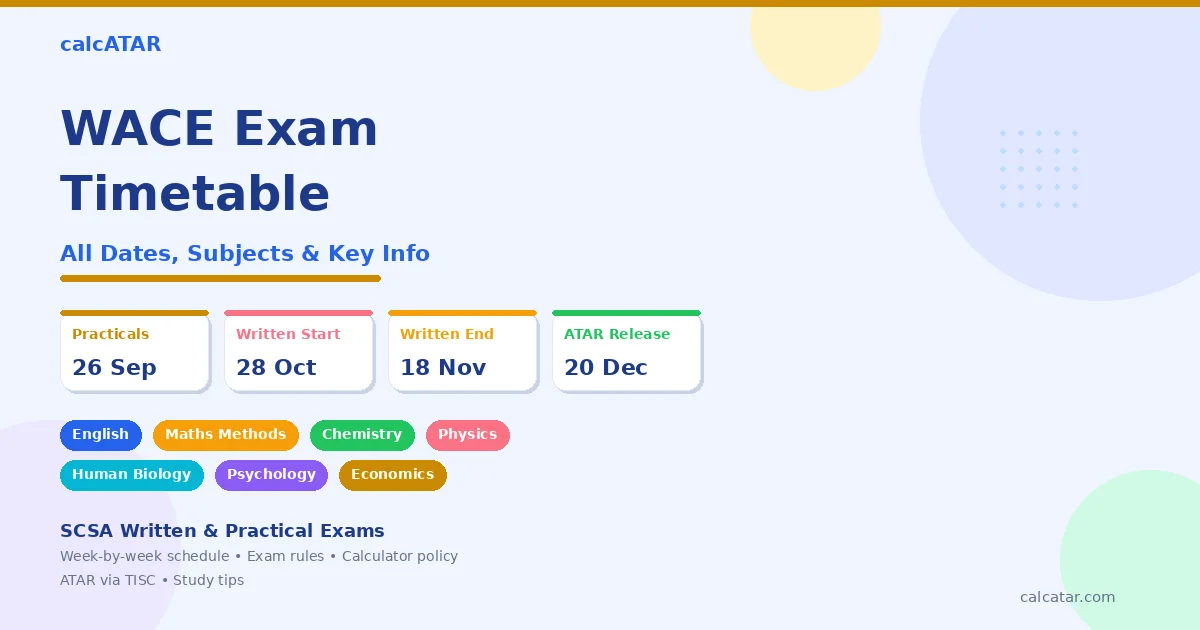
📅 Practical exams: Saturday 26 September – Sunday 25 October 2026
📝 Written exams: Wednesday 28 October – Wednesday 18 November 2026
📘 First written exam: Aviation & Psychology — Wednesday 28 October, 9:20 AM
📊 WACE results released: Mid-December 2026 (exact date TBC by SCSA)
🎓 WA ATAR released: Sunday 20 December 2026 via TISC
📋 Personalised timetables: Available from Tuesday 8 September 2026 via SCSA Student Portal
🔗 Estimate your ATAR now: WACE ATAR Calculator
📖 Table of Contents
The 2026 WACE examination period is the final assessment stage for Year 12 students in Western Australia. Your written exam results contribute 50% of your final scaled score for each ATAR course — the other 50% comes from your school-based assessments. SCSA (School Curriculum and Standards Authority) runs the exams, and TISC (Tertiary Institutions Service Centre) uses your results to calculate your ATAR.
This timetable covers every ATAR course exam scheduled by SCSA for 2026 — including practical exams (September–October), interstate language exams, and the full written exam period (October–November). Whether you are sitting English, Maths Methods, Chemistry, or one of the 50+ other ATAR courses, your exam date, session time, and duration are listed below.
How WACE Exams Work
The WACE examination system has two phases — practical exams first, then written exams. Here is how it fits together:
| Step | What Happens | When |
|---|---|---|
| 1. Practical Exams | Performance, oral, and production exams for subjects like Dance, Drama, Music, and Languages (oral component) | 26 Sep – 25 Oct 2026 |
| 2. Written Exams | Three-hour written exams for all ATAR courses. Each exam has 10 minutes reading time before writing begins. | 28 Oct – 18 Nov 2026 |
| 3. Marking & Scaling | SCSA marks exams, calculates scaled scores, and confirms WACE achievement | Nov – Dec 2026 |
| 4. Results & ATAR | SCSA releases WACE results. TISC calculates and releases ATARs. | Mid-Dec & 20 Dec 2026 |
2026 WACE Practical Exam Timetable
Practical exams run before the written exam period. They cover performance subjects (Dance, Drama, Music) and oral language exams. Your school will confirm your specific date and venue — the ranges below are the examination windows set by SCSA.
| Subject | Exam Window | Venue |
|---|---|---|
| Dance | 26 Sep – 3 Oct | Sacred Heart College |
| Drama | 28 Sep – 3 Oct | Hale School + country venues |
| Music | 29 Sep – 4 Oct | Hale School |
| Aviation (Practical) | 1 October | 303 Sevenoaks St, Cannington |
| Language Orals (Chinese, French, German, Hindi, Indonesian, Italian, Japanese, Korean, Punjabi, Tamil) | 10 – 25 Oct | Applecross SHS, Shenton College, Rossmoyne SHS (varies by language) |
| Interstate Languages | Sep – Oct | 303 Sevenoaks St, Cannington |
2026 WACE Written Exam Timetable
All ATAR course written exams are 3 hours long with 10 minutes reading time before writing begins. Morning sessions start at 9:20 AM and afternoon sessions start at 2:00 PM. This timetable is sourced directly from the official SCSA 2026 examination schedule.
Interstate Language Exams (Before Main Period)
| Date | Day | Time | Subject | Duration |
|---|---|---|---|---|
| Thursday 15 October | ||||
| 15 Oct | Thu | 11:00 AM | Auslan, Bengali, Bosnian, Croatian, Dutch, Filipino, Hebrew, Hungarian, Karen, Khmer, Macedonian, Persian, Polish, Portuguese, Romanian, Russian, Serbian, Sinhala, Swedish, Turkish | 10 min reading + 2 hrs |
| 15 Oct | Thu | 11:00 AM | Japanese: Background Language, Chinese: Background Language | 10 min reading + 2.5 hrs |
| Tuesday 3 November | ||||
| 3 Nov | Tue | 11:00 AM | Modern Greek, Spanish | 10 min reading + 2 hrs |
| Wednesday 4 November | ||||
| 4 Nov | Wed | 8:45 AM | Vietnamese | 15 min reading + 2 hrs |
| Friday 6 November | ||||
| 6 Nov | Fri | 12:00 PM | Arabic | 15 min reading + 2 hrs |
Week 1 — Wednesday 28 October to Friday 30 October
| Date | Day | Time | Subject | Duration |
|---|---|---|---|---|
| Wednesday 28 October | ||||
| 28 Oct | Wed | 9:20 AM | Aviation, Psychology | 3 hrs (+ 10 min reading) |
| 28 Oct | Wed | 2:00 PM | Engineering Studies, Indonesian: Second Language, Korean: Second Language | 3 hrs (+ 10 min reading) |
| Thursday 29 October | ||||
| 29 Oct | Thu | 9:20 AM | Agribusiness, Chemistry, Computer Science | 3 hrs (+ 10 min reading) |
| 29 Oct | Thu | 2:00 PM | German: Background Language, Ancient History | 3 hrs (+ 10 min reading) |
| Friday 30 October | ||||
| 30 Oct | Fri | 9:20 AM | English | 3 hrs (+ 10 min reading) |
| 30 Oct | Fri | 2:00 PM | English as an Additional Language or Dialect | 3 hrs (+ 10 min reading) |
Week 2 — Monday 2 November to Friday 6 November
| Date | Day | Time | Subject | Duration |
|---|---|---|---|---|
| Monday 2 November | ||||
| 2 Nov | Mon | 9:20 AM | Agricultural Science & Technology, Mathematics Methods | 3 hrs (+ 10 min reading) |
| 2 Nov | Mon | 2:00 PM | Applied Information Technology, Chinese: Second Language | 3 hrs (+ 10 min reading) |
| Tuesday 3 November | ||||
| 3 Nov | Tue | 9:20 AM | Literature, Dance | 3 hrs (+ 10 min reading) |
| 3 Nov | Tue | 2:00 PM | German: Second Language, Media Production & Analysis | 3 hrs (+ 10 min reading) |
| Wednesday 4 November | ||||
| 4 Nov | Wed | 9:20 AM | Physics | 3 hrs (+ 10 min reading) |
| 4 Nov | Wed | 2:00 PM | Chinese: First Language, Indonesian: Background Language, Politics & Law | 3 hrs (+ 10 min reading) |
| Thursday 5 November | ||||
| 5 Nov | Thu | 9:20 AM | Human Biology, Drama | 3 hrs (+ 10 min reading) |
| 5 Nov | Thu | 2:00 PM | Outdoor Education | 3 hrs (+ 10 min reading) |
| Friday 6 November | ||||
| 6 Nov | Fri | 9:20 AM | Mathematics Applications | 3 hrs (+ 10 min reading) |
| 6 Nov | Fri | 2:00 PM | Japanese: Second Language, Materials Design & Technology | 3 hrs (+ 10 min reading) |
Week 3 — Monday 9 November to Friday 13 November
| Date | Day | Time | Subject | Duration |
|---|---|---|---|---|
| Monday 9 November | ||||
| 9 Nov | Mon | 9:20 AM | Food Science & Technology, Mathematics Specialist, Biology | 3 hrs (+ 10 min reading) |
| 9 Nov | Mon | 2:00 PM | French: Background Language, Korean: Background Language | 3 hrs (+ 10 min reading) |
| Tuesday 10 November | ||||
| 10 Nov | Tue | 9:20 AM | Economics, Marine & Maritime Studies | 3 hrs (+ 10 min reading) |
| 10 Nov | Tue | 2:00 PM | Punjabi: Background Language, Visual Arts | 3 hrs (+ 10 min reading) |
| Wednesday 11 November | ||||
| 11 Nov | Wed | 9:20 AM | Business Management & Enterprise, Geography | 3 hrs (+ 10 min reading) |
| 11 Nov | Wed | 2:00 PM | Tamil: Background Language | 3 hrs (+ 10 min reading) |
| Thursday 12 November | ||||
| 12 Nov | Thu | 9:20 AM | Modern History, Physical Education Studies | 3 hrs (+ 10 min reading) |
| 12 Nov | Thu | 2:00 PM | Italian: Background Language | 3 hrs (+ 10 min reading) |
| Friday 13 November | ||||
| 13 Nov | Fri | 9:20 AM | Accounting & Finance, Earth & Environmental Science | 3 hrs (+ 10 min reading) |
| 13 Nov | Fri | 2:00 PM | Philosophy & Ethics, Religion & Life | 3 hrs (+ 10 min reading) |
Week 4 — Monday 16 November to Wednesday 18 November
| Date | Day | Time | Subject | Duration |
|---|---|---|---|---|
| Monday 16 November | ||||
| 16 Nov | Mon | 9:20 AM | Health Studies, French: Second Language | 3 hrs (+ 10 min reading) |
| 16 Nov | Mon | 2:00 PM | Hindi: Background Language | 3 hrs (+ 10 min reading) |
| Tuesday 17 November | ||||
| 17 Nov | Tue | 9:20 AM | Design, Music | 3 hrs (+ 10 min reading) |
| Wednesday 18 November | ||||
| 18 Nov | Wed | 9:20 AM | Italian: Second Language | 3 hrs (+ 10 min reading) |
Popular Subjects: Quick Reference
If you are sitting one of the high-enrolment ATAR courses, here are your dates at a glance:
| Subject | Date | Day | Session |
|---|---|---|---|
| English | 30 Oct | Friday | 9:20 AM |
| Mathematics Methods | 2 Nov | Monday | 9:20 AM |
| Mathematics Applications | 6 Nov | Friday | 9:20 AM |
| Mathematics Specialist | 9 Nov | Monday | 9:20 AM |
| Chemistry | 29 Oct | Thursday | 9:20 AM |
| Physics | 4 Nov | Wednesday | 9:20 AM |
| Human Biology | 5 Nov | Thursday | 9:20 AM |
| Biology | 9 Nov | Monday | 9:20 AM |
| Psychology | 28 Oct | Wednesday | 9:20 AM |
| Economics | 10 Nov | Tuesday | 9:20 AM |
| Modern History | 12 Nov | Thursday | 9:20 AM |
| Geography | 11 Nov | Wednesday | 9:20 AM |
| Physical Education Studies | 12 Nov | Thursday | 9:20 AM |
| Accounting & Finance | 13 Nov | Friday | 9:20 AM |
| Literature | 3 Nov | Tuesday | 9:20 AM |
| Computer Science | 29 Oct | Thursday | 9:20 AM |
ATAR Courses vs Non-ATAR Courses
Not every WACE course counts towards your ATAR. Understanding the difference is critical for Year 12 subject selection — and for knowing which exams you actually need to sit.
| Feature | ATAR Course | General Course | Foundation Course |
|---|---|---|---|
| External exam? | Yes — 50% of final score | No external exam | No external exam |
| Counts towards ATAR? | Yes | No | No |
| School assessment weight | 50% | 100% | 100% |
| University pathway | Direct entry via TISC | Alternative pathways only | Foundation/bridging courses |
| Scaling applied? | Yes — by TISC | Not applicable | Not applicable |
| Examples | English, Maths Methods, Chemistry, Physics, Economics | English General, Maths Essential, Sport & Rec | English Foundation, Maths Foundation |
How Your WACE Results Become Your ATAR
WA has a unique ATAR calculation pathway compared to other states. Here is how your exam performance translates into a university rank:
| Step | What Happens | Who Does It |
|---|---|---|
| 1. Raw exam marks | Your written exam is marked by SCSA examiners and given a raw score | SCSA |
| 2. Combined score | Your exam mark (50%) is combined with your school assessment mark (50%) to produce a combined score for each subject | SCSA |
| 3. Scaling | Combined scores are scaled to account for differences in difficulty between subjects and cohorts | TISC |
| 4. TEA calculation | TISC adds your best four scaled scores (plus 10% of your next best score, if available) to produce your TEA (Tertiary Entrance Aggregate) | TISC |
| 5. ATAR conversion | Your TEA is converted to an ATAR — a national percentile rank from 0 to 99.95 | TISC |
WACE Exam Rules & What to Bring
What You Must Bring
- Approved student identification — your SCSA Student Statement of Entry or school-issued photo ID
- Blue or black pens (at least two — no erasable pens)
- Pencils, eraser, and ruler
- SCSA-approved calculator (for applicable subjects) with memory cleared
- Clear water bottle with the label removed
What You Must NOT Bring
- Mobile phones, smartwatches, or any electronic devices (even if switched off)
- Notes, textbooks, or any reference materials (unless specified by SCSA for that subject)
- Correction fluid or correction tape
- Unapproved calculators or calculator covers/cases with notes
- Food (unless approved through special provisions)
10 Tips for WACE Exam Preparation
What Happens After WACE Exams
Once your last written exam wraps up on 18 November, here is the timeline:
| Date | Event | What You Need to Do |
|---|---|---|
| 18 November 2026 | Last WACE written exam | Relax — you have earned it |
| Late November | TISC preference deadline approaching | Finalise your TISC course preferences (you can still change until the deadline) |
| Mid-December 2026 | WACE results released by SCSA | Log into the SCSA Student Portal to see your subject results and WACE achievement |
| Sunday 20 December 2026 | WA ATAR released by TISC | Log into your TISC account to see your ATAR and TEA |
| 20 Dec – late Jan | Change of preference window | Update your TISC preferences based on your actual ATAR |
| Late January 2027 | TISC Round 1 offers | Accept, defer, or wait for subsequent rounds |
| February 2027 | Subsequent TISC rounds | Additional offers — cutoffs often drop by 2–5 points in later rounds |
Frequently Asked Questions
Final Thoughts
The WACE exam period is a three-week sprint that determines half your final score in every ATAR course. The students who perform best are the ones who know their timetable cold, download their personalised schedule on 8 September, and walk into every session with no surprises about format, timing, or what they can bring.
I really suggest you bookmark this timetable, mark your personal exam dates in a calendar, and start working backwards from 28 October right now. Estimate your ATAR with the WACE ATAR Calculator to see where you stand, and use that number to set your TISC preferences strategically. After your ATAR drops on 20 December, the change of preference window is your most powerful tool — have your backup courses researched and ready.
Good luck, Western Australia. You have got this.
— Daniel Mitchell, calcATAR